
Your Swing Starts Before Your Hands Move
When parents watch their child hit, it is easy to focus on the hands. Are they keeping their hands inside the ball? Are they getting the barrel through the zone? Are they dropping their hands?
But a powerful and efficient baseball or softball swing starts before the hands ever move toward the ball.
The lower body, hips, pelvis, trunk, and upper body all contribute to the swing. The ability to create and transfer force through this sequence is what allows a hitter to produce bat speed without relying entirely on the arms.
That does not mean every hitter needs to have the same swing. There is no single “perfect” swing that every athlete should copy. The goal is to understand how the body creates and transfers force—and whether the athlete has the physical qualities necessary to do it effectively.
Quick answer: Swing power is a full-body process. Force begins with the athlete interacting with the ground, moves through the legs and hips, transfers through the trunk and upper body, and eventually reaches the bat. Strength matters, but the ability to sequence and control that movement matters too.
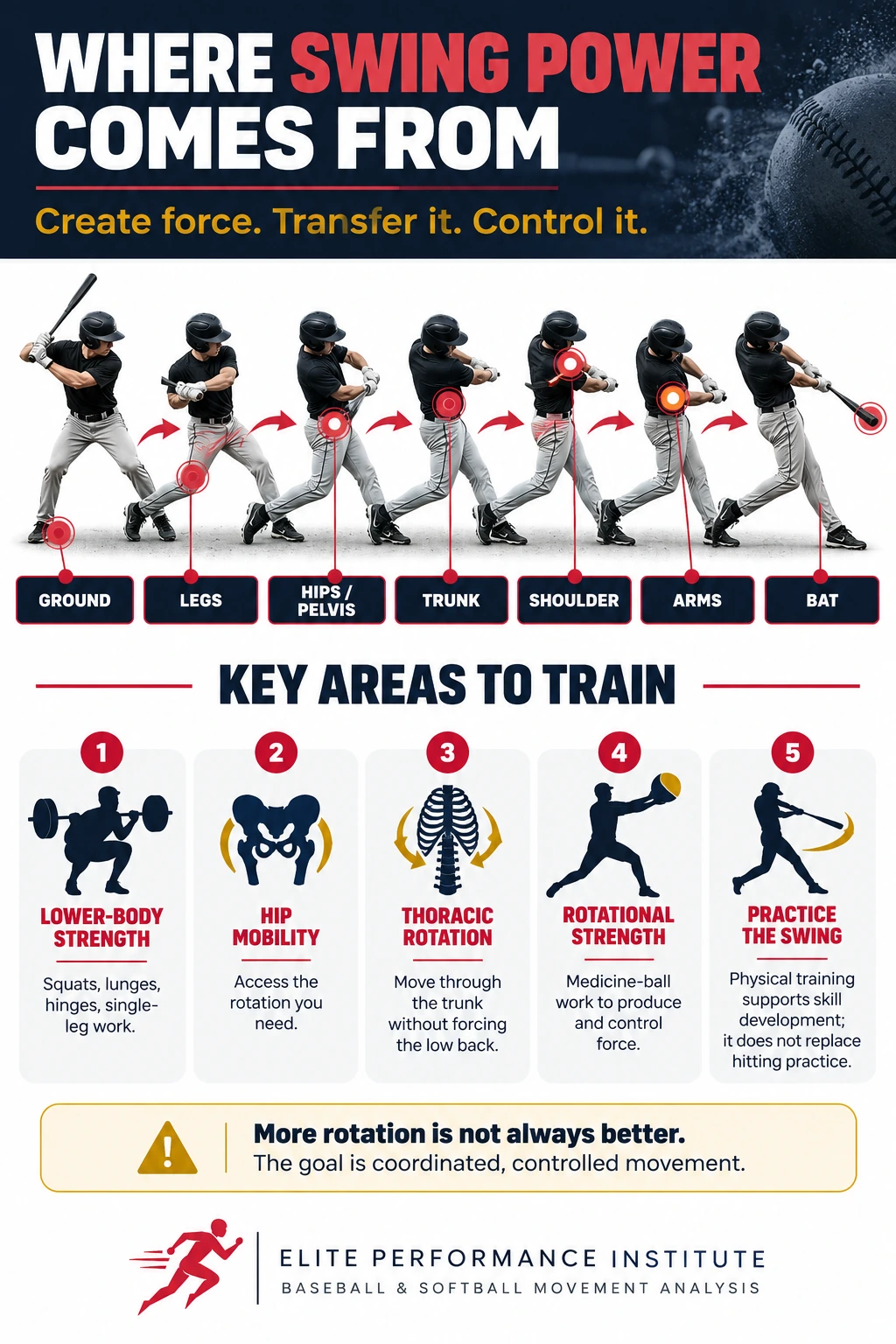
Swing power is a coordinated sequence: create force from the ground, transfer it through the body, and control it into the bat.
Where Does Swinging Power Come From?
A baseball or softball swing is a full-body movement. Although the hands ultimately control the bat, they are not responsible for generating all of the force behind the swing.
The movement begins with the athlete interacting with the ground. The legs and lower body provide a foundation, while the hips and pelvis contribute to rotation. That movement is then transferred through the trunk and into the upper body and arms.
Think of the swing as a sequence
Ground → Legs → Hips/Pelvis → Trunk → Shoulder → Arms → Bat
Each part contributes to the movement. The goal is not necessarily to move every segment as quickly as possible. It is to coordinate those segments so that force can be transferred efficiently into the bat.
That is why a hitter can have strong arms but still struggle to generate consistent bat speed. Strength matters, but how an athlete uses that strength matters too.
Why Do the Hips Matter So Much?
The hips and pelvis play an important role in the rotational demands of hitting.
When a hitter begins the swing, the lower body can initiate rotation while the upper body maintains its position long enough to create an effective sequence. The pelvis then continues to rotate as the trunk and upper body contribute to the movement.
This does not mean that a hitter should simply “spin their hips.” Excessive or poorly controlled rotation can be just as problematic as insufficient rotation.
The important quality is controlled rotation. A hitter needs enough hip mobility to access the positions required by the swing and enough strength and coordination to control those positions while producing force.
That is why hip mobility and rotational control are two of the areas we commonly look at during a Baseball & Softball Movement Analysis.
Your Arms Can’t Do It Alone
One of the easiest ways to appreciate the importance of the lower body is to take it away.
Try swinging a bat while keeping your lower body completely still. You can still move the bat, but the movement becomes much more dependent on the trunk, shoulders, and arms.
Now compare that with a coordinated swing where the athlete can use the ground, rotate through the hips, transfer that movement through the trunk, and then allow the upper body and hands to deliver the bat.
The goal is not to eliminate the contribution of the arms. The arms are an important part of the swing. The goal is to avoid asking the arms to do everything.
When the lower body and trunk contribute effectively, the hitter has another way to generate and transfer force.
Mobility Isn’t the Same as Rotation
Having good hip or thoracic mobility does not automatically make someone a better hitter.
An athlete may have plenty of available motion but struggle to use it during a dynamic movement. That is the difference between mobility and movement control.
For example, a hitter may demonstrate adequate hip rotation during a mobility test but struggle to control that rotation while standing on one leg and producing force.
The same concept applies to the thoracic spine. A hitter needs enough thoracic rotation to participate in the swing, but they also need the strength and coordination to control that movement.
This is why simply stretching an athlete is not always the answer. Sometimes the athlete does not need more range of motion. They need to learn how to use the range of motion they already have.
For athletes who truly need more mid-back motion, the EPI Exercise Library includes options such as the Thoracic Rotation Open Book and other thoracic mobility exercises.
What Is Separation?
You may have heard coaches talk about “separation” in hitting. This generally refers to the relationship between the rotation of the pelvis and the rotation of the upper trunk during the swing.
As the lower body begins to rotate, the upper body can maintain its position briefly before rotating through. This creates a sequence in which different parts of the body contribute at different times.
However, separation should not be treated as a magic number that every hitter needs to maximize. More separation is not automatically better.
The athlete still needs to control the position and transfer that movement efficiently. For young athletes, the priority should be developing the strength, mobility, and coordination necessary to create and control rotation—not forcing them into an exaggerated position.
What Happens When the Sequence Breaks Down?
When an athlete has difficulty using the lower body or controlling rotation, they may develop compensatory movement strategies.
Some hitters may rely heavily on their arms. Others may rotate the upper body too early. Some may have difficulty maintaining posture through the swing, while others may struggle to transfer force from the lower body into the bat.
These movement patterns can potentially affect:
- Bat speed
- Timing
- Contact consistency
- Ability to adjust to different pitches
- Balance throughout the swing
- Efficiency of movement
Important: A particular movement pattern should not automatically be labeled as “bad.” Every athlete has individual anatomy, experience, strength, mobility, coordination, and skill. The better question is whether the athlete has the physical capacity and control to perform the movement effectively.
Looking Beyond the Swing
This is why evaluating a hitter involves more than watching them take swings.
A hitter may have difficulty rotating because of limited hip mobility. Or the issue may be related to thoracic mobility, single-leg stability, trunk strength, rotational control, or simply a lack of experience coordinating the movement.
These factors can look very different when you take the athlete out of the batter’s box and evaluate their physical abilities separately.
For example, if a hitter struggles to rotate through the hips during a swing and also demonstrates limited hip rotation during a movement assessment, that gives us additional information about what may be contributing to the movement.
The goal is not to change a swing simply because it looks different. The goal is to determine whether the athlete has the physical tools to perform the movement they are being asked to perform.
That is also the purpose behind our Baseball & Softball Movement Analysis: looking at the body behind the mechanics rather than evaluating video in isolation.
What Should Baseball & Softball Players Train?
Young hitters do not need an endless list of complicated “baseball exercises.” They need a foundation of general athletic qualities that can eventually be applied to their sport.
1
Build Lower-Body Strength
Squatting, lunging, hinging, and single-leg exercises can help develop the strength needed to interact with the ground and control the lower body.
Good options in the EPI Exercise Library include the Split Squat and Single-Leg RDL.
2
Develop Hip Mobility
Adequate hip mobility allows athletes to access the positions required for rotation. Mobility should be individualized rather than assuming every athlete automatically needs more range of motion.
Browse the Hip Mobility Exercise Library for additional options.
3
Train Thoracic Rotation
The trunk needs to rotate effectively during the swing. Controlled rotational movements can help athletes develop both mobility and control.
The Thoracic Rotation Open Book, Thread the Needle, and other thoracic mobility drills can be useful starting points when appropriate.
4
Develop Rotational Strength
Medicine-ball throws and other rotational exercises can help athletes learn to produce and control force through the trunk and hips.
Our Medicine Ball Throw Library includes rotational power drills such as the Kickstand Rotational Med Ball Slam.
5
Practice the Swing
Physical training does not replace hitting practice. The athlete ultimately needs to learn how to apply these physical qualities to the actual swing.
Strength and movement training should support skill development—not compete with it.
What Should Parents Look For?
Parents do not need to become hitting coaches or analyze every part of their child’s swing.
Instead, pay attention to the bigger picture.
- Does your child have difficulty maintaining balance?
- Do they appear to generate most of the swing with their arms?
- Do they struggle to rotate through the hips or trunk?
- Do they consistently fatigue during repeated swings?
- Do they have difficulty producing or controlling rotation?
- Most importantly, are they experiencing pain?
These observations do not automatically indicate a problem, but they can help identify when a more comprehensive evaluation may be useful.
The Bottom Line for Baseball & Softball Players
Your child’s swing starts before their hands move.
The legs, hips, pelvis, trunk, shoulder, and arms all contribute to the process of creating and transferring force into the bat.
That does not mean every hitter needs the same swing or that more hip rotation automatically means more power.
Effective hitting is about creating, sequencing, and controlling movement—not simply moving as much as possible.
For young baseball and softball athletes, developing lower-body strength, hip and thoracic mobility, rotational control, and overall athleticism can provide the physical foundation needed to develop their swing.
The goal is not to build a perfect swing.
It is to build an athlete who has the physical capacity to create, transfer, and control force—and then teach them how to apply those qualities at the plate.
Frequently Asked Questions
Where does power in a baseball or softball swing come from?
Swing power is a full-body process. The athlete interacts with the ground, produces force through the lower body, transfers it through the hips and trunk, and eventually delivers that movement into the arms and bat.
Why are the hips important in hitting?
The hips and pelvis contribute to rotation and help connect lower-body force to the trunk. The goal is not simply to rotate more, but to have enough mobility, strength, and control to rotate effectively.
What does separation mean in a baseball or softball swing?
Separation generally describes the relationship between pelvis rotation and upper-trunk rotation. The lower body can begin to rotate while the upper body briefly maintains its position, creating a coordinated sequence. More separation is not automatically better.
What should young hitters train off the field?
A strong foundation can include lower-body strength, hip mobility, thoracic rotation, rotational strength, single-leg control, and general athleticism. Physical training should support hitting practice rather than replace it.
Does every hitter need the same swing?
No. Athletes have different anatomy, mobility, strength, coordination, experience, and skill. The goal is not to force every hitter into one model but to make sure the athlete has the physical capacity to perform their swing effectively.
Want a Closer Look at How Your Athlete Moves?
Our Baseball & Softball Throwing & Hitting Analysis combines video review with mobility, strength, stability, and movement testing. The goal is to understand the body behind the swing and give the athlete a practical plan based on what we actually find.
This article is for general educational purposes and is not medical advice. Exercise and movement recommendations should be individualized when pain, injury, medical conditions, or other specific concerns are present.