
Shin Splints vs. Stress Fracture: How to Tell the Difference
Shin pain is one of those problems I have seen over and over again from both sides of my career. After 18 years coaching track and field and years working clinically as a sports chiropractor, I have evaluated a lot of runners and athletes who come in saying some version of the same thing:
“I think I have shin splints—but how do I know it isn't a stress fracture?”
That is an important question because not every case of shin pain should be managed the same way. Some athletes have medial tibial stress syndrome—what most people mean when they say “shin splints”—and may be able to continue some level of activity with the right modifications. Others may have a bone stress injury that needs much more protection from impact.
The frustrating part is that there is not one home test, one pain score, or even one imaging study that should be interpreted in isolation. The location of the pain, how focal the tenderness is, how symptoms behave with loading, the athlete's training history, bone-health factors, and imaging when indicated all have to be considered together.
Quick answer: “Shin splints” usually describes medial tibial stress syndrome (MTSS), which classically produces more diffuse pain and tenderness along the posteromedial tibia. A tibial bone stress injury is more concerning when pain becomes increasingly focal, progresses with impact, begins affecting walking or daily activity, or does not behave like typical MTSS. Early X-rays can be normal, and even MRI findings need to be interpreted alongside the athlete's symptoms and examination.1, 2
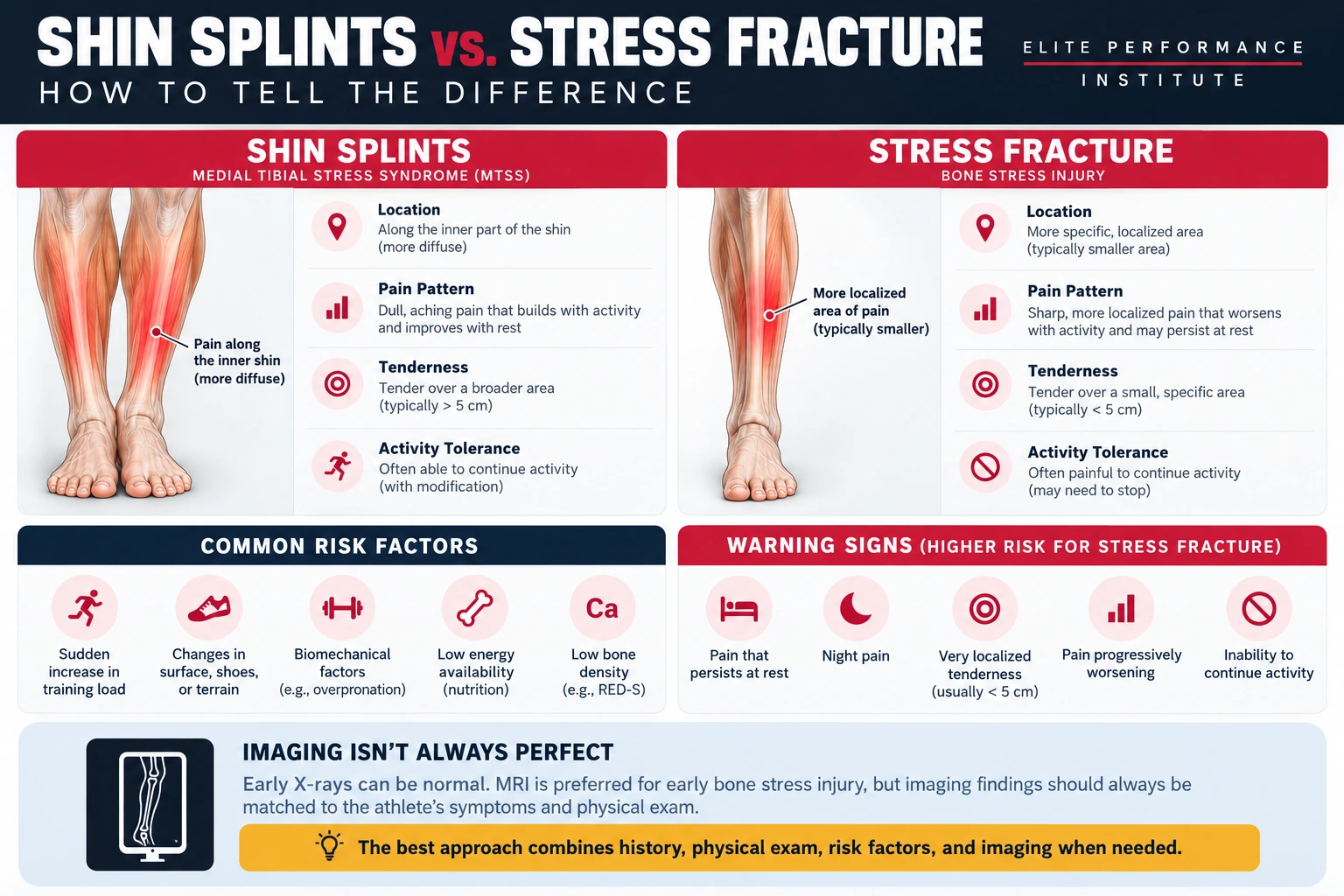
Shin splints tend to create a broader area of posteromedial tibial pain, while bone stress injuries are often more focal and progressively sensitive to impact.
First: “Shin Splints” Is a Pretty Broad Term
When people say “shin splints,” they are usually referring to medial tibial stress syndrome, or MTSS.
Current clinical definitions describe MTSS as exercise-induced pain along the distal posteromedial border of the tibia with recognizable tenderness over a length of 5 centimeters or more.1
That last part matters.
With typical MTSS, the athlete often points to a broader strip of tenderness rather than one tiny spot on the bone.
Symptoms commonly show up with running and jumping, especially after a change in training, and may initially warm up or become more manageable as the athlete gets moving. As symptoms become more irritated, they may last longer into or after activity.
MTSS is not simply a muscle being “tight.” Current research describes it as a multifactorial overuse condition that likely involves tibial bone loading and remodeling along with surrounding tissue contributions.3
What Is a Tibial Stress Fracture?
I actually prefer the broader term bone stress injury because a stress fracture is usually not an all-or-nothing event.
Bone stress injuries exist along a continuum. Repetitive loading can create bone microdamage faster than the bone is able to remodel and recover. Early in that process, there may be a stress reaction without a visible fracture line. If loading continues to outpace recovery, the injury can progress toward a more advanced stress injury or a true stress fracture.2
That distinction is one reason I do not use an X-ray as the end-all for guiding shin or bone pain. In practice, I am usually looking at the radiology report alongside the athlete's symptoms, where the tenderness is located, how the pain responds to loading, and what changed in training.
A normal X-ray can be reassuring, but it does not completely exclude an early bone stress injury. If the overall presentation still points toward bone stress, that deserves more attention rather than relying on the X-ray alone.
Shin Splints vs. Stress Fracture: What Are the Biggest Differences?
| Finding | More Typical of Shin Splints / MTSS | More Concerning for Bone Stress Injury |
|---|---|---|
| Tenderness | Broader or diffuse area along the posteromedial tibia, classically ≥5 cm. | More focal bony tenderness over a smaller area. |
| Pain with running | Often exercise-related and may initially warm up or remain manageable. | Often becomes progressively easier to reproduce as impact continues. |
| Walking / daily activity | Often relatively comfortable in milder cases. | Pain with walking or daily weight-bearing raises my concern. |
| Progression | May fluctuate with training load. | Often becomes more persistent, focal, and easier to provoke if loading continues. |
| Imaging | Often diagnosed clinically; imaging may be unnecessary in a straightforward presentation. | Imaging becomes more useful when clinical suspicion for bone stress injury is meaningful. |
| Training decision | Activity may sometimes be modified rather than completely stopped. | Impact often needs to be reduced or stopped until the injury is appropriately evaluated and protected. |
None of those findings alone proves the diagnosis. I am looking for the pattern.
Localized bony tenderness is one of the most important examination findings in suspected bone stress injury, particularly when it matches a history of progressive pain with impact.4
What About the Hop Test?
The single-leg hop test is commonly used when evaluating shin pain, but I do not treat it as a simple pass-or-fail test for a stress fracture.
If hopping reproduces focal tibial pain, that can add to my concern for a bone stress injury. Research also suggests that combining the hop test with the location of pain and tenderness can improve the clinical picture.5
The important part is that no single exam test can reliably rule a bone stress injury in or out. I use the hop test as one piece of information along with the location of tenderness, how symptoms respond to impact, whether normal walking hurts, and the athlete's recent training history.
Imaging Helps—but Imaging Is Not Perfect
This is one of the most important points for runners, parents, and coaches to understand.
X-Rays Can Be Normal Early
Plain X-rays are often the first imaging study ordered when a bone stress injury is suspected because they are accessible, inexpensive, and useful for identifying more advanced injuries.
The problem is early sensitivity.
A systematic review found reported sensitivity for conventional radiographs of only about 12% to 56% for lower-extremity stress fractures.6
In a study of adolescent athletes with tibial bone stress injuries confirmed on MRI, all original radiographs had been read as normal. On later specialist review, radiographic abnormalities could be identified in only 27% of the MRI-positive injuries, with X-ray findings much more likely as injury grade increased.7
A normal early X-ray does not automatically rule out a bone stress injury. If the clinical story remains concerning, that matters.
MRI Is Better—but It Still Needs Clinical Context
MRI is generally considered the preferred imaging study for detecting an early bone stress injury because it can identify periosteal and bone marrow changes before a fracture line appears on X-ray.8
But I also do not treat an MRI report in isolation.
Research has found MRI stress-type changes in athletes who have no symptoms at all. One study found tibial stress reactions on MRI in 43% of asymptomatic collegiate distance runners, and those findings did not predict who later developed a symptomatic stress injury.9
A systematic review has also shown that asymptomatic bone marrow edema is common and dynamic in athletes and military trainees.10
And although MRI is our best early imaging tool, it is not mathematically perfect. Rare cases of anterior tibial cortex stress fracture have even been reported with relatively unremarkable MRI findings while radiographs and CT demonstrated the injury.11
The point is not that imaging is unreliable. The point is that history, examination, and imaging should agree with each other.
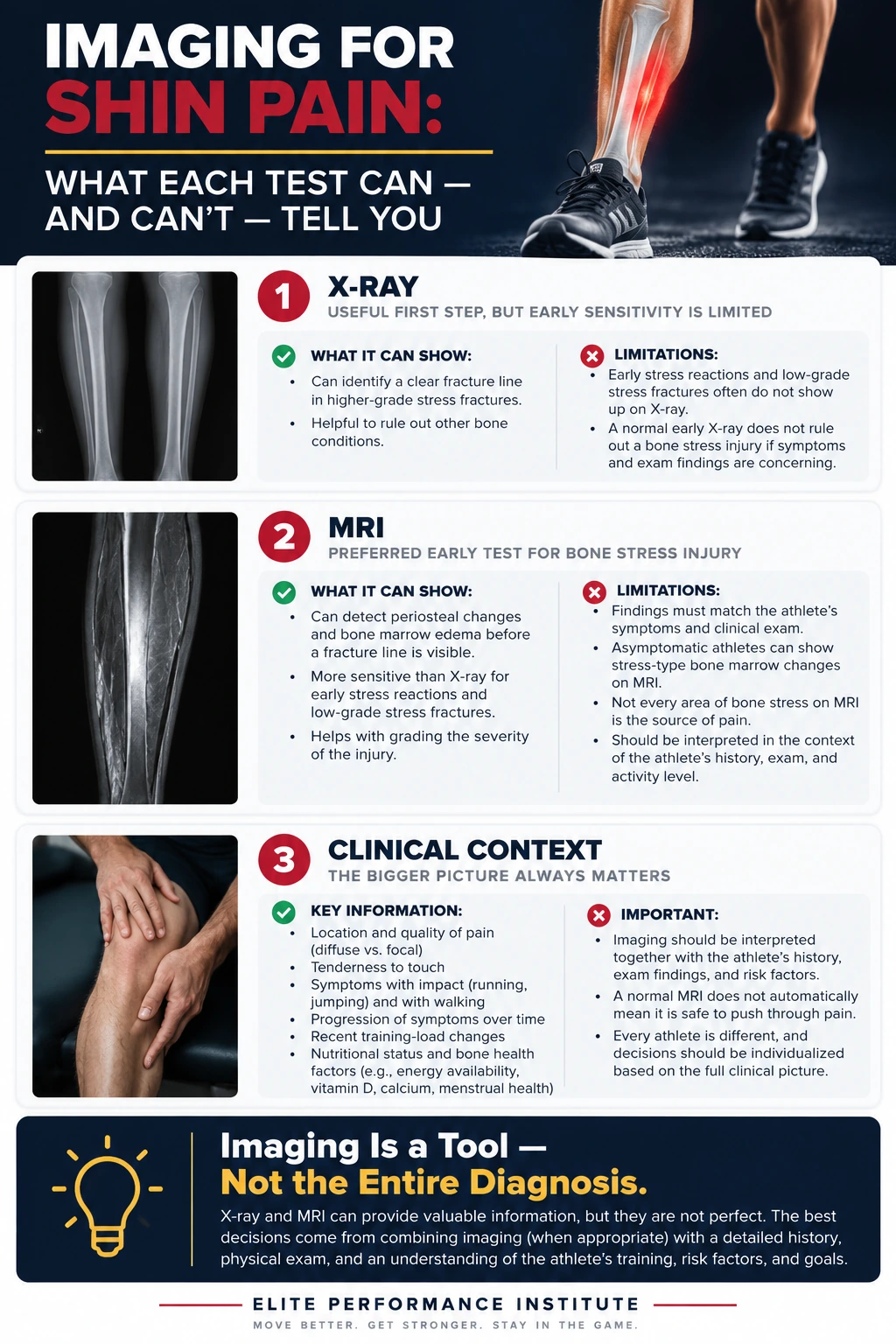
Imaging is useful, but neither a normal early X-ray nor an isolated MRI finding should be interpreted without the athlete's history and examination.
Why Do Shin Splints and Bone Stress Injuries Happen?
In both coaching and clinical practice, I rarely think there is one single reason.
The better way to think about these injuries is load versus capacity. The tibia has to tolerate the repetitive forces created by running and jumping. Problems develop when the amount or type of loading repeatedly exceeds the athlete's current ability to recover and adapt.
1. Training Load
A rapid increase in mileage, sprint volume, jumping, hills, intensity, practices, meets, or total weekly impact can push tissue demand up faster than the athlete adapts. Bone stress injury consensus statements specifically identify rapid transitions in training load as an important risk factor.2
2. Nutrition, Vitamin D & Iron Status
Bone remodeling depends on adequate energy intake and the nutrients needed to support bone health. When a bone stress injury is a concern, two things I pay particular attention to are vitamin D and iron status, including ferritin. A recent sports-medicine review recommends considering 25-hydroxyvitamin D, a CBC, and an iron panel including ferritin as part of the minimum metabolic workup for athletes with bone stress injury.17 Low energy availability, menstrual dysfunction, low testosterone, low bone mass, and inadequate overall intake also remain important pieces of the picture.2, 12
3. Biomechanics
Biomechanics can influence how load is distributed, but there is not one “bad running form” that explains every case. MTSS research has found associations with factors such as navicular drop or foot posture, certain hip and ankle motion characteristics, and gait-related variables—but these findings are variable and should not be treated as a single cause.13, 14
4. Recovery & Bone Health
Sleep, recovery between hard sessions, previous bone stress injury, bone density, hormonal health, and overall medical history can all change the amount of loading an athlete can tolerate. The same training plan can be reasonable for one runner and excessive for another.
5. Footwear & Surface Changes
A sudden change in habitual footwear or training environment can change the stresses applied to the lower extremity. That does not mean one shoe prevents shin pain, but major changes deserve to be considered as part of the overall load picture.2
6. Previous Injury & Experience
Prior running injury and previous MTSS have been associated with future MTSS risk, and less running experience has also appeared in systematic reviews. History matters because tissue capacity is partly shaped by what the athlete has been exposed to before.15
What I Look at in the Clinic
When a runner or athlete comes in with shin pain, I am not just pressing on the shin and deciding whether it hurts.
I want to know:
- Exactly where the pain is located and how large the tender area is.
- Whether symptoms are diffuse or focal.
- When the pain starts during activity and whether it progresses as the session continues.
- Whether walking, stairs, or normal daily activity now hurt.
- Whether there was a recent jump in mileage, intensity, sprinting, hills, jumping, or competition volume.
- Whether the athlete recently changed shoes or training surfaces.
- Whether there is a prior history of shin pain or bone stress injury.
- Calf, soleus, ankle, foot, hip, and single-leg strength and control.
- Running mechanics when that information is relevant.
- Vitamin D and iron status, including ferritin, when a bone stress injury is a concern, along with overall energy availability and menstrual or hormonal history when appropriate.
I am not looking for one single thing to blame. I am trying to figure out which combination of training load, recovery, strength, mechanics, and bone-health factors may be contributing to the athlete's shin pain—and which of those factors we can actually change.
Can You Keep Running With Shin Splints?
Sometimes—but this is where correctly identifying the problem matters.
With a more typical MTSS presentation, I may be comfortable keeping some level of running in the program if symptoms remain mild, mechanics are not being significantly altered, and the athlete recovers appropriately afterward.
Our Pain Stoplight can be useful for general load management, but I do not use the Pain Stoplight as permission to push through a suspected bone stress injury.
If I am genuinely concerned about a tibial bone stress injury, the decision changes. Continuing to repeatedly load an irritated bone can allow the injury to progress. That is the time to reduce impact and obtain the appropriate evaluation rather than trying to win a pain-tolerance contest.
How Is Treatment Different?
For Medial Tibial Stress Syndrome
The first goal is usually to reduce the amount of irritating load without automatically shutting the athlete down longer than necessary.
Depending on the presentation, that may involve adjusting running volume or intensity, changing the balance of hard and easy days, temporarily reducing jumps or sprinting, and building lower-leg capacity.
Strength work may include calf and soleus loading, tibialis anterior work, foot and ankle strengthening, and proximal strength when it is relevant to the athlete.
Useful starting points in the EPI Exercise Library include the Anterior Tibialis Raise, Single-Leg Calf Raise, and our full Calf & Achilles Exercise Library.
For a Bone Stress Injury
Management depends on the location and severity of the injury.
The first step is reducing the mechanical load enough for the bone to recover. Some athletes simply need impact removed temporarily. Others may require protected weight-bearing, a boot, or additional medical management depending on the site and grade of the injury.2
Nutrition and bone-health factors also need to be addressed rather than focusing only on the painful shin.
An anterior tibial cortex stress fracture deserves particular respect because the anterior tibia is considered a higher-risk stress-fracture location with a greater risk of delayed healing or progression.16
When I Would Be More Concerned About a Stress Fracture
- Pain is becoming very focal over one small area of bone.
- Pain is progressively worsening with running or jumping.
- The athlete has started to hurt with normal walking or daily activity.
- Symptoms are no longer settling between sessions.
- There has been a major recent increase in training load.
- There is a history of prior bone stress injury.
- There are concerns about low energy availability, menstrual dysfunction, low testosterone, low bone density, or significant nutritional restriction.
- Pain is located along the anterior tibial cortex rather than the more typical posteromedial MTSS region.
- The clinical picture feels more concerning than the initial X-ray suggests.
The Bottom Line
After 18 years coaching track and field, I have seen plenty of athletes try to call every case of shin pain “shin splints” and keep training through it.
Not every sore shin is a stress fracture, and many athletes with shin pain are dealing with a more typical case of medial tibial stress syndrome. The problem is assuming that all shin pain is harmless and continuing to load it the same way when the symptoms are becoming more focal, more persistent, or more painful with everyday activity.
The biggest distinction I am looking for is the overall pattern: diffuse posteromedial tenderness that behaves like MTSS versus increasingly focal bone pain that becomes more persistent and load-sensitive. Training history, daily symptoms, bone-health factors, examination findings, and imaging when appropriate all help complete that picture.
And remember: imaging is a tool, not the entire diagnosis. Early X-rays can miss bone stress injuries, while MRI can show stress-type changes in athletes who have no symptoms at all.
The best decision comes from matching the imaging to the athlete standing in front of you.
Frequently Asked Questions
Where do shin splints usually hurt?
Typical medial tibial stress syndrome causes pain and tenderness along the posteromedial tibia, usually over a broader area rather than one tiny focal spot.
Is focal shin pain more concerning for a stress fracture?
It can be. Increasingly focal bony tenderness, especially when paired with progressive pain during impact or pain with walking, increases concern for a bone stress injury. It is not diagnostic by itself.
Can an X-ray miss a tibial stress fracture?
Yes. Early X-rays have relatively low sensitivity for bone stress injury and can be normal before enough bone change develops to become visible.
Is MRI always accurate for stress fractures?
MRI is the preferred early imaging study and is much more sensitive than plain radiographs, but it still needs clinical correlation. Stress-type MRI findings can appear in asymptomatic athletes, and rare false-negative MRI cases have also been reported.
Can vitamin D or low ferritin matter with a bone stress injury?
They can be relevant. Vitamin D plays an important role in bone health, and iron status—including ferritin—is commonly considered when evaluating athletes with bone stress injuries. Neither value diagnoses a stress fracture by itself, but low vitamin D, low iron stores, inadequate energy availability, and other bone-health factors can be important parts of the overall evaluation.
Can biomechanics cause shin splints?
Biomechanics can contribute to the way load is distributed, but there is no single movement pattern or foot type that explains every case. Training load, recovery, prior injury, strength, nutrition, and individual anatomy also matter.
Should I stop running if I have shin pain?
It depends on the diagnosis and severity. Mild MTSS may sometimes be managed with modified running, while suspected bone stress injury generally requires a more cautious reduction in impact until it is appropriately evaluated.
Not Sure If Your Shin Pain Is Just Shin Splints?
If shin pain keeps returning, is becoming more focal, or is interfering with running and training, an individualized evaluation can help determine what you are dealing with and what needs to change.
At Elite Performance Institute, I work with runners and athletes to evaluate the painful area, training history, strength, mobility, running mechanics when appropriate, and the other factors that may be contributing to the problem.
References
- Winters M. The diagnosis and management of medial tibial stress syndrome: an evidence update. Unfallchirurg. 2020;123(Suppl 1):15-19. PubMed
- Hoenig T, Hollander K, Popp KL, et al. International Delphi consensus on bone stress injuries in athletes. Br J Sports Med. 2025;59:78-90. View consensus
- Medial tibial stress syndrome. 2026 narrative review. PubMed
- Schroeder JD, Trigg SD, Capo Dosal GE. Bone Stress Injuries: Diagnosis and Management. Am Fam Physician. 2024;110(6):592-600. PubMed
- Medial tibial stress fracture diagnosis and treatment guidelines. PubMed
- Wright AA, Hegedus EJ, Lenchik L, Kuhn KJ, Santiago L, Smoliga JM. Diagnostic Accuracy of Various Imaging Modalities for Suspected Lower Extremity Stress Fractures: A Systematic Review With Evidence-Based Recommendations for Clinical Practice. PubMed
- Retrospective Review of Radiographic Imaging of Tibial Bony Stress Injuries in Adolescent Athletes With Positive MRI Findings. PubMed
- Imaging of bone stress injury in runners. 2026 review. PubMed
- Bergman AG, Fredericson M, Ho C, Matheson GO. Asymptomatic tibial stress reactions: MRI detection and clinical follow-up in distance runners. PubMed
- Asymptomatic Bone Marrow Edema in Weight-bearing Bones in Athletes and Military Trainees: A Systematic Literature Review. PubMed
- Smith R, et al. Negative magnetic resonance imaging in three cases of anterior tibial cortex stress fractures. PubMed
- Mountjoy M, Ackerman KE, Bailey DM, et al. 2023 International Olympic Committee's consensus statement on Relative Energy Deficiency in Sport (REDs). Br J Sports Med. 2023;57:1073-1097. View consensus
- Risk Factors for Medial Tibial Stress Syndrome in Active Individuals: An Evidence-Based Review. PubMed
- How Medial Tibial Stress Syndrome Is Affected by Alignment, Range of Motion, Strength, and Gait Biomechanics: A Systematic Review and Meta-Analysis. PubMed
- Medial Tibial Stress Syndrome in Active Individuals: A Systematic Review and Meta-analysis of Risk Factors. PubMed
- McInnis KC, Ramey LN. High-Risk Stress Fractures: Diagnosis and Management. PubMed
- Metabolic Workup for Bone Stress Injury: A Practical Approach for Evaluating Bone Health in Athletes. 2026. PubMed
This article is for general educational purposes and is not intended to diagnose shin pain or replace an individualized medical evaluation. Bone stress injuries can progress if they continue to be loaded, and athletes with concerning symptoms should be appropriately evaluated before returning to impact activity.