
How Much Pain Is Okay During Exercise? Using the Pain Stoplight System
One of the most common questions I get in the clinic is, “What can I do exercise-wise if I have pain?”
A lot of people assume exercise should be completely pain-free. Others take the opposite approach and feel like they should just push through whatever they are feeling.
I think there is a much more useful middle ground. Over the years, I have used a simple Pain Stoplight analogy with patients to help decide when it is okay to keep moving, when we should modify what we are doing, and when it is time to stop and back off.
The Pain Stoplight: I use 0–3/10 pain as Green, 4–5/10 as Yellow, and 6–10/10 as Red. The pain number matters, but so does what happens afterward. If symptoms are clearly worse the following morning, that is a sign the previous day's activity was probably too much.
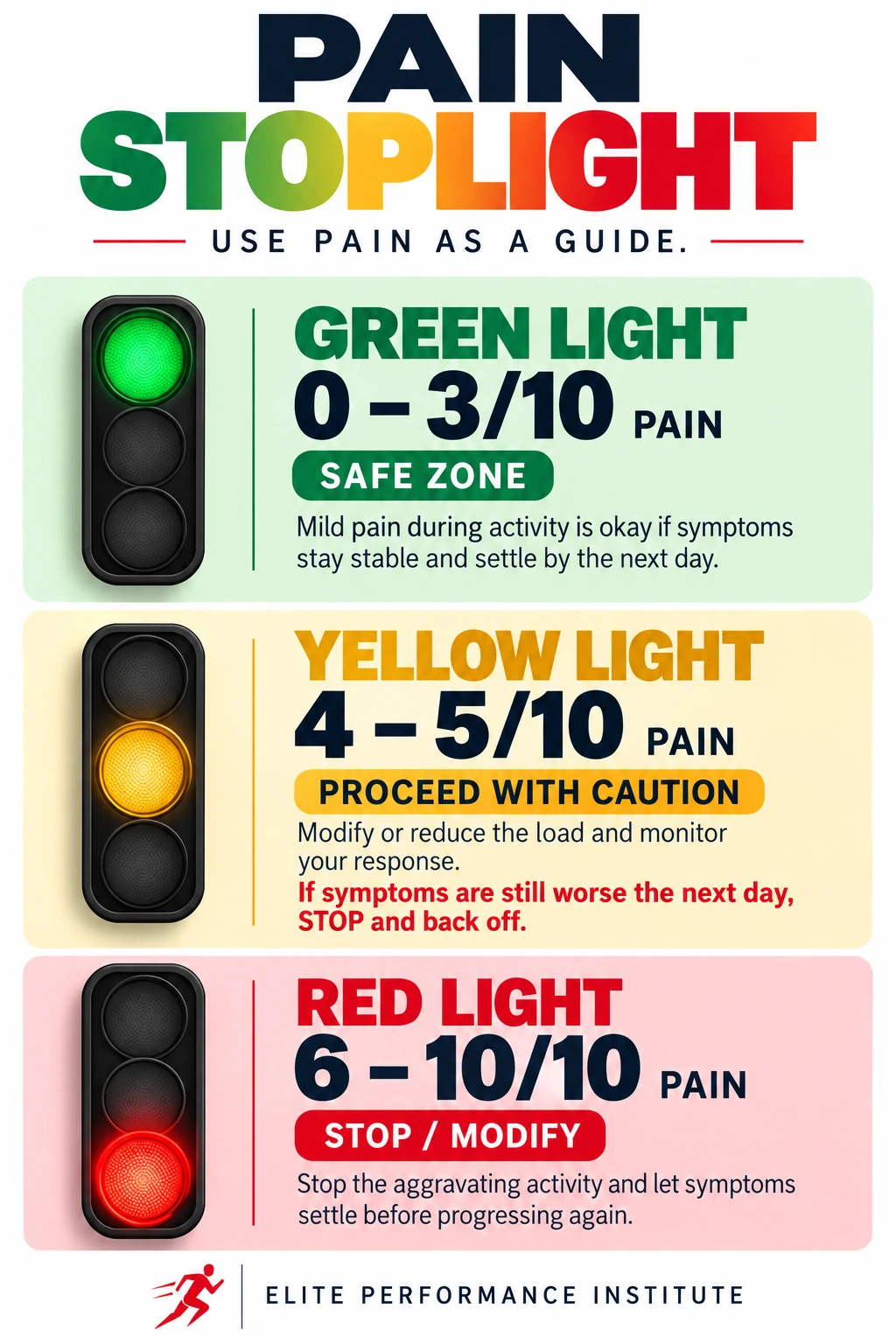
The Pain Stoplight uses green, yellow, and red zones to help guide activity based on pain during exercise and how symptoms respond afterward.
Does Pain Mean You Need to Stop Exercising?
Not necessarily.
Pain is useful information, but I do not think the goal of rehabilitation always needs to be completely pain-free exercise.
Instead, I want to know how much pain someone is having, whether it stays stable or keeps increasing, whether it changes the way they move, and how they respond afterward.
That is where the three zones become useful.
Green Light: 0–3/10 Pain
Safe Zone
The Green Zone is pain between 0 and 3 out of 10.
This is generally the range I am comfortable working in during rehabilitation. Mild discomfort during an exercise does not automatically mean you are hurting yourself.
What I want to see is that the symptoms remain mild and controlled.
- Pain stays around 0–3/10.
- It does not continue getting worse as you exercise.
- You can move normally without significantly changing your technique.
- Symptoms settle afterward.
- You are back around your normal baseline by the following morning.
If those things are happening, I am usually comfortable continuing the current exercise or gradually progressing it.
Yellow Light: 4–5/10 Pain
Proceed With Caution
The Yellow Zone is pain between 4 and 5 out of 10.
I do not automatically interpret Yellow as meaning you damaged something. I look at it as feedback that the current exercise or activity may be getting close to what you can tolerate right now.
That may mean we need to modify the dose instead of completely stopping.
- Use less weight or resistance.
- Perform fewer repetitions or sets.
- Shorten the duration of the activity.
- Reduce the range of motion when appropriate.
- Use an easier or lower-impact variation.
- Stay at the current level instead of progressing.
The Yellow Zone is also where the response over the next several hours and the following morning becomes especially important.
The Next Morning Matters
This is one of the most important parts of how I use the Pain Stoplight.
An activity can feel okay while you are doing it and still leave you significantly more irritated afterward.
For example, maybe an exercise reaches 4/10 pain. You finish the workout, the discomfort settles, and the following morning you feel basically the same as you did before the session.
That is very different from waking up the next day significantly more painful, stiff, or limited.
My morning-after rule: If symptoms are clearly worse the following morning, I consider the previous day's load too aggressive. I do not want to progress from there. Instead, reduce the load, volume, duration, range, or impact and return to something that was better tolerated.
If you briefly enter the Yellow Zone but return to your normal baseline by the next morning, I may simply keep the current dose the same for a little longer before trying to progress.
The goal is not just to survive the exercise. The goal is to give the body an amount of stress it can actually recover from.
Red Light: 6–10/10 Pain
Stop or Modify
Once pain reaches 6/10 or higher, we are in the Red Zone.
At that point, I generally want to stop or significantly modify the aggravating activity.
The goal of rehab is not to see how much pain you can tolerate. We want enough load to help the body adapt without repeatedly creating large flare-ups.
If an exercise is creating high pain, pain that is rapidly worsening, or pain that causes you to significantly change the way you move, it is usually time to back off.
- Stop or significantly reduce the aggravating activity.
- Reduce the load or volume.
- Return to an easier variation.
- Use a lower-impact option when appropriate.
- Allow symptoms to settle before progressing again.
Not Every Type of Pain Should Be Treated the Same
The Pain Stoplight is a general guide for managing exercise and activity. It is not a rule that should be applied to every injury.
The diagnosis and situation still matter.
I would be more cautious and consider getting evaluated with symptoms such as:
- Significant trauma.
- Suspected bone stress injury.
- Rapid or substantial swelling or bruising.
- Difficulty bearing weight normally.
- Joint locking or significant instability.
- Numbness, tingling, or other neurologic symptoms.
- Sudden, severe, or unexpected pain.
Those situations are different from working through mild discomfort during a controlled rehabilitation exercise.
Look at the Bigger Picture
I also do not want someone judging their entire rehabilitation process based on one individual workout.
Symptoms naturally fluctuate. What matters more is the trend over time.
Are you getting stronger? Are you able to tolerate more activity? Are you recovering better? Are flare-ups happening less often? Are your morning symptoms gradually improving?
For example, having 2/10 discomfort during an exercise does not bother me nearly as much if you are gradually lifting more weight, tolerating more running, and feeling better from week to week.
That tells me much more than whether every individual repetition was completely pain-free.
The Bottom Line
When something hurts, the answer is not always to stop everything.
The Pain Stoplight is simply a way to use symptoms as feedback and make better decisions about how much exercise or activity you can tolerate.
Green 0–3/10: Keep going if symptoms remain mild and settle back to baseline.
Yellow 4–5/10: Be thoughtful. Modify or hold the current dose and pay close attention to how you feel afterward and the following morning.
Red 6–10/10: Stop or significantly modify the aggravating activity and let symptoms settle before trying to progress again.
The goal is not always zero pain during every exercise.
The goal is to find the amount of activity your body can tolerate, recover from, and gradually build on over time.
Not Sure What You Should Be Doing With Pain?
If pain keeps limiting exercise, running, sports, or everyday activity, an individualized evaluation can help determine what you can keep doing, what should be modified, and what needs to be strengthened next.
At Elite Performance Institute, we work with runners, athletes, and active adults to build progressive rehabilitation plans designed to get you back to the activities you enjoy.
This article is for general educational purposes and is not medical advice. Exercise and activity recommendations should be individualized when pain, injury, medical conditions, or other specific concerns are present.