
Why Does My Hip Hurt When I Run? Causes, Exercises & When to Worry
Hip pain is one of those frustrating running injuries because two runners can point to roughly the same area and have completely different problems.
After 18 years of coaching track and field and years working with runners in my chiropractic and sports rehabilitation clinic, I have learned that the first question usually isn't “Which hip stretch should I do?” It is “Where exactly is the pain, when does it show up, and what changed?”
Maybe your hip feels fine for the first mile and starts aching once you get tired. Maybe the outside hurts after running, or you feel a pinch deep in the front of your hip when you pick up the pace. Others describe a nagging pain in the buttock that gets worse on hills or during speed work. Those details matter, because not all hip pain responds to the same exercises—or even the same running modifications.
Quick answer: Hip pain when running may come from the hip flexors, gluteal tendons, proximal hamstring, hip joint, or even the low back. Front/groin pain, outside-of-the-hip pain, and buttock pain can point us toward different possibilities, but pain location by itself cannot make a diagnosis. Training changes, tenderness, range of motion, strength testing, and symptom response all help determine the next step. Deep groin pain with a limp or pain with ordinary walking deserves particular attention because a bone stress injury must be considered.12
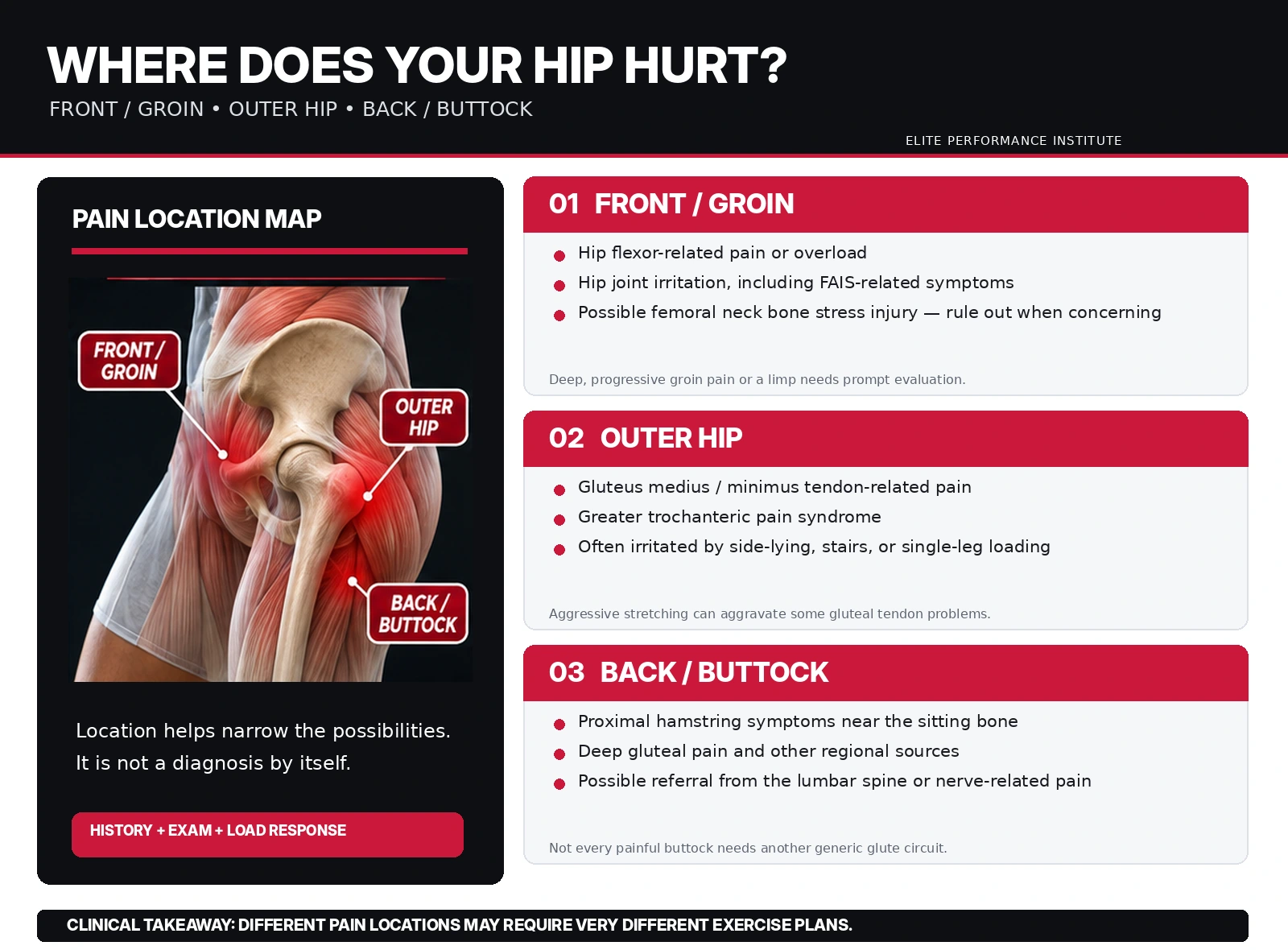
Start With Where Your Hip Hurts
If you take one thing away from this article, I want it to be this: hip pain is not one injury. I am going to divide it into three regions because that is a useful starting point, but they overlap. You can have pain from the joint, a muscle or tendon, and a referred source at the same time.1
1. Front / groin
Hip flexor-related problems, hip joint irritation, labral or impingement-related symptoms, and—in some runners—bone stress injury.
2. Outside of hip
Gluteal tendinopathy and greater trochanteric pain syndrome are common possibilities, especially with side-lying or stair pain.
3. Back / buttock
Proximal hamstring tendon symptoms, deep gluteal pain, and symptoms referred from the lumbar spine or pelvis.
Front of the Hip or Groin: Hip Flexor, Hip Joint, or Something Else?
Runners with front-of-hip pain might describe discomfort when driving the knee forward, sprinting, running uphill, or lifting the leg into the car. The iliopsoas and other hip flexors can be involved, particularly when there has been a sudden increase in demand. However, a deep pinch in the groin with certain hip positions may raise questions about the hip joint itself, including femoroacetabular impingement syndrome (FAIS) or labral-related pain.12
I would not diagnose a labral tear just because you hear a click, or FAIS because one hip feels tight. Imaging findings and positive provocative tests do not always explain the pain in front of us. The history, examination, and response to activity still matter.25
The big exception I do not want runners to overlook is a femoral neck bone stress injury. Deep groin or anterior hip pain that is worsening with impact, changes your stride, or starts hurting with walking deserves prompt medical assessment—not an aggressive hip-flexor stretching routine. Early X-rays can miss these injuries, and MRI may be needed when clinical suspicion remains high.67
Outside of the Hip: It Is Not Always “Bursitis”
If your pain is located over the bony outside of the hip, one possibility is greater trochanteric pain syndrome. This is an umbrella term that often involves the gluteus medius or gluteus minimus tendons, sometimes with associated bursal irritation. It is frequently referred to as “hip bursitis,” but that label does not tell the whole story.13
Clues can include pain when lying on the affected side, standing on one leg, going up stairs, or increasing your running volume. One detail I pay attention to is whether positions that compress the outside of the hip—such as hanging on one hip while standing or crossing the legs—are aggravating things.
More stretching is not automatically the answer here. Aggressive stretches that pull the hip across the body may increase compression over an already irritated gluteal tendon. For some runners, the better starting point is to reduce those aggravating positions and gradually build the hip's strength and loading tolerance.34
One of the stronger studies in this area compared education and progressive exercise, a corticosteroid injection, and a wait-and-see approach in adults with persistent gluteal tendinopathy. The education-and-exercise group had better global improvement than the other groups at eight weeks, with an advantage in global improvement still present at one year. The study involved mostly middle-aged adults—not specifically a group of competitive runners—so we should apply its principles thoughtfully rather than pretend it tested every running injury.3
Back of the Hip or Buttock: Think Beyond the Glutes
Pain in the buttock can come from several places. If the pain is right around the sitting bone, proximal hamstring tendinopathy may be on the list. Runners sometimes notice that kind of pain with faster running, hills, hinging movements, or prolonged sitting. Pain farther into the buttock—especially with tingling, numbness, or symptoms down the leg—can raise other possibilities, including nerve-related pain or symptoms referred from the low back.14
That distinction changes the exercise plan. Someone with an irritated proximal hamstring tendon might not tolerate aggressive hamstring stretching or deep hip-flexion loading early on, while someone whose symptoms are coming from the lumbar spine may need an entirely different assessment and approach. I do not want to hand every runner a generic glute circuit and assume the problem is solved.
Why Did My Hip Start Hurting in the First Place?
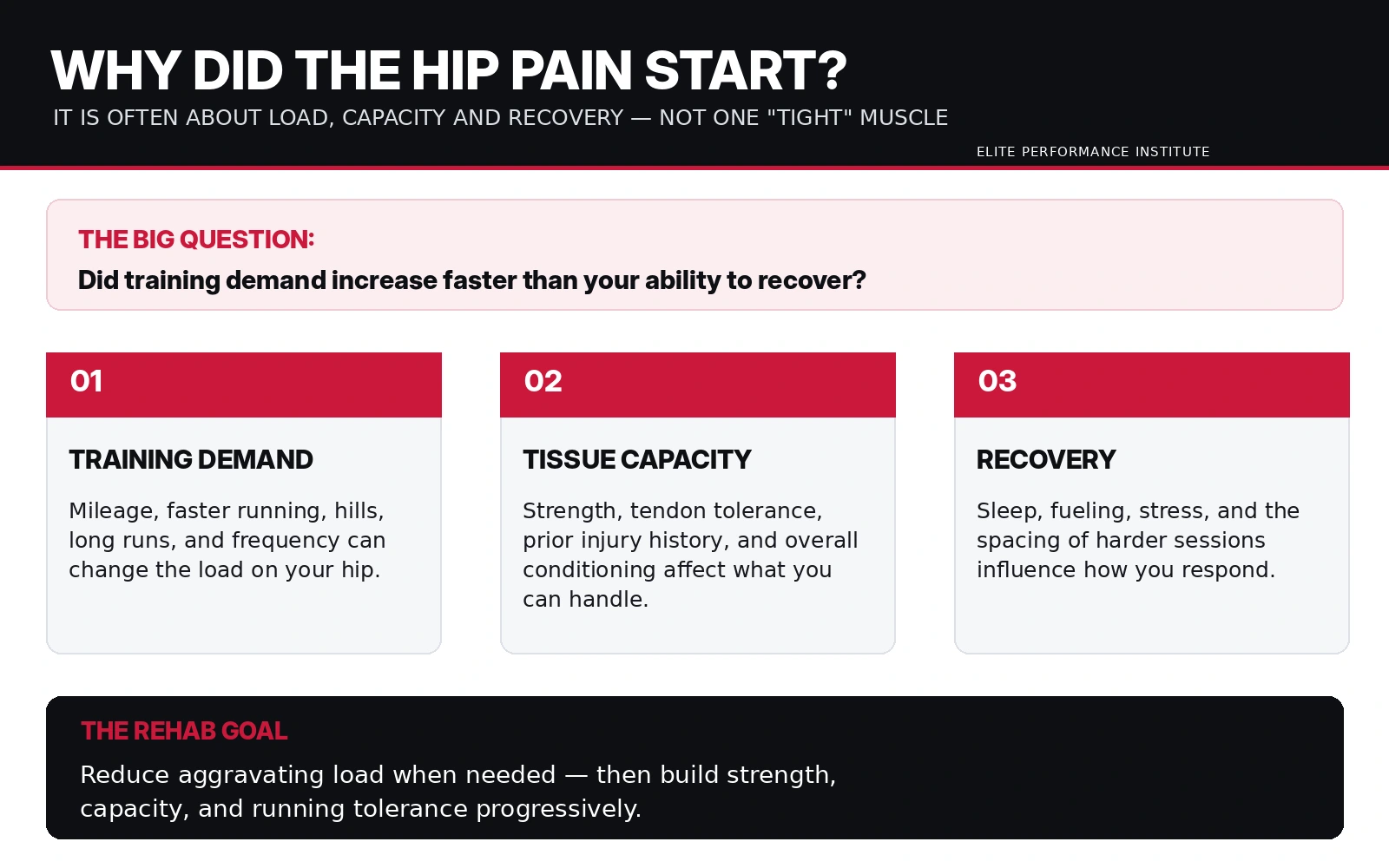
Sometimes there is a clear event: a sprint, an awkward step, or a sudden pull. More often, especially in distance runners, symptoms have built up over time. These are some of the things I ask about:
- Training load: Did weekly mileage, long-run distance, frequency, speed work, or hill running increase?
- Strength and capacity: Are the muscles and tendons being asked to handle more load than they are ready for?
- Recovery: Have sleep, fueling, or recovery opportunities changed while training demand increased?
- Previous symptoms: Has the same hip been bothering you intermittently for weeks or months?
- Movement demands: Is pain linked to faster paces, inclines, longer runs, or fatigue rather than every run?
For runners with possible bone stress injury, energy availability, bone health, and previous stress injuries are especially important to review. I never want to reduce every running injury to one “tight” muscle or one thing we see on a running video.
Could Hip Drop, Weak Glutes, or Your Running Form Be Part of It?
Absolutely—they can be pieces of the puzzle. But I am careful with the wording here.
Running is repeated single-leg loading. The gluteus medius and minimus contribute to lateral hip and pelvic control, while the gluteus maximus helps produce and control hip extension. A runner may show more pelvic drop or trunk lean when fatigue sets in. That gives me something useful to assess, but it does not automatically prove that the movement pattern caused the injury.
There is no one perfect running form for everybody. In my running analysis sessions, I look at the full picture: symptoms, strength, mobility, training history, and video of the runner. I am much more interested in finding a few modifiable factors than making someone chase a supposedly perfect stride.
I also wrote a separate guide on my favorite glute exercises for runners if you want a deeper explanation of glute max versus glute med/min training. This article is about determining which type of hip pain you may be dealing with first.
Can You Keep Running With Hip Pain?
This is usually the question runners want answered most. The answer depends on what we think is irritated and how symptoms behave—not just whether you can technically finish a run.
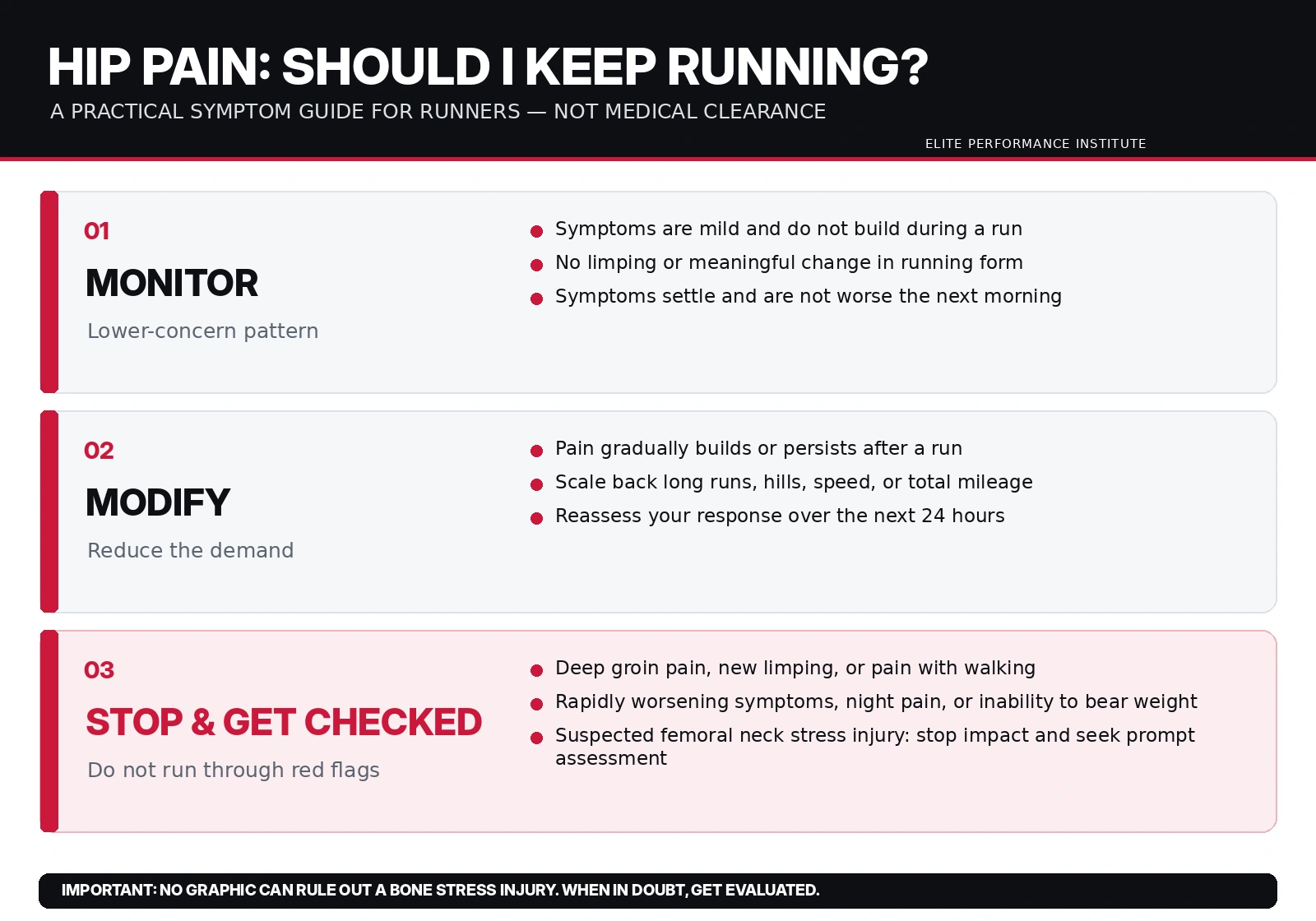
If the pain is mild, does not worsen as you run, does not change your stride, and settles back to baseline without a worse next-day response, some runners with non-serious musculoskeletal conditions may be able to continue with a modified workload while they address the problem. That is not a universal rule or permission to run through undiagnosed hip pain.
If symptoms build throughout the run, cause you to limp, or are worse with ordinary walking or hopping, I am much less comfortable treating that as routine soreness. In particular, suspected femoral neck bone stress injury warrants stopping impact and prompt medical evaluation; do not use a pain score or hop test to clear yourself to run.67
How I Generally Think About Modifying Running
- Temporarily reduce the trigger—often long runs, speed work, hills, or total mileage—rather than changing five variables at once.
- Use your symptoms during, later that day, and the following morning to judge the response, not just how you felt in the first ten minutes.
- If even easy running causes progressively worse symptoms, do not keep testing it every day.
- Once symptoms and function improve, rebuild duration and intensity gradually, one major variable at a time.
I have also written about this in my Pain Stoplight Exercise Pain Guide. It is a framework for discussing symptom response—not a substitute for excluding injuries that should not be loaded.
When Hip Pain Is Something I Would Want Checked Sooner
Do not keep running and “see if it loosens up” if you have:
- Deep groin or front-of-hip pain with a limp, pain bearing weight, or pain during normal walking.
- Pain that is progressively worsening with impact, especially after a training spike or with a history of bone stress injury.
- An acute fall or injury followed by severe pain or an inability to bear weight.
- Fever, significant unexplained illness, or a hot/swollen joint.
- New significant weakness, numbness, or neurologic symptoms.
Severe injury or inability to bear weight needs urgent medical assessment. Possible femoral neck stress injury should be medically evaluated promptly even if an initial X-ray is normal.6
Five Exercises I Use for Hip Strength and Running Rehabilitation
Once we have a better idea of what is causing the hip pain, the next step is finding exercises that address the specific limitations without making symptoms worse. For a lot of runners, that includes improving lateral hip strength, hip extension strength, single-leg control, and trunk strength. Mobility work can be useful too, but only when there is a reason to include it.
These are five exercises I commonly use in some form with runners. They are not meant to be a one-size-fits-all program. Which exercises we choose, how much we load them, and when we progress them depend on the injury and how the runner responds. I've included demonstrations from the EPI Exercise Library below.
1. Side-Lying Hip Abduction — Glute Medius Strength
Side-lying hip abduction is a great starting point for building strength through the gluteus medius and minimus. The setup is important: keep your hips stacked, position the top leg in line with or slightly behind your body, and raise it without rolling backward or using your low back to create the movement. You don't have to lift the leg very high to make this effective.
As strength improves, I like progressing the exercise by slowing the lowering phase, adding a pause at the top, or eventually using an ankle weight. It is a useful foundation before progressing to more demanding single-leg exercises. As with any exercise, the position and resistance should be adjusted if they aggravate an irritable hip.
See the Side-Lying Hip Abduction for Glute Medius exercise guide .
2. Modified Side Plank With Hip Abduction — Hip and Trunk Strength
This is a more challenging progression that combines lateral hip strengthening with trunk control. The bottom leg and side of the trunk help support the body while the top leg performs the hip abduction. I want the pelvis to stay steady rather than dropping or rotating as the leg lifts.
It is a good option once someone has built a base of hip strength, but I would not automatically start here if the outside of the hip is particularly sensitive. We can work up to this exercise as loading tolerance improves.
See the Modified Side Plank With Hip Abduction exercise guide .
3. Single-Leg Glute Bridge — Hip Extension Strength
Single-leg glute bridges are an easy way to challenge hip extension strength and see whether someone can maintain control from one side to the other. I want the movement to come primarily from the hip without excessive arching through the low back or rotating the pelvis.
For somebody who has trouble with this variation, I may start with a standard two-leg bridge and progress from there. I would also be more cautious with this exercise if it reproduces pain around the sitting bone, especially when the proximal hamstring tendon is irritated.
See the Single-Leg Glute Bridge exercise guide .
4. Box Step-Up — Single-Leg Strength
Running is a series of single-leg loading cycles, so I want runners to eventually be able to handle meaningful strength work on one leg. Step-ups are one of my favorite exercises for that. We can change the box height, add resistance, slow the lowering phase, or increase the volume as a runner gets stronger.
The box doesn't need to be high to be effective. I would rather see someone control a lower step than use momentum and compensate through a higher one.
See the Box Step-Up exercise guide .
5. Triplanar Dynamic Hip Flexor Stretch — Hip Mobility
Not every runner with hip pain needs to stretch their hip flexors. However, when I find a genuine limitation in hip extension, a controlled dynamic stretch can be a useful part of the program. This variation allows us to address mobility in multiple directions without holding one position for an extended period.
I don't want anyone forcing through a pinch in the front of the hip or deep groin pain. That is a reason to reassess the exercise and the source of the symptoms, not stretch harder.
See the Triplanar Dynamic Hip Flexor Stretch exercise guide .
Remember: These exercises serve different purposes, and not all five belong in every runner's program. Strength should be progressed based on the condition, symptoms, and training goals. Suspected bone stress injuries need medical evaluation before returning to impact or trying to exercise through the pain.
How Much Strength Work Should a Runner Be Doing?
I am a big believer in meaningful strength training for runners. If a runner is able to tolerate it, I usually want a progression toward actual resistance—not an endless collection of exercises that never get harder. That may mean a couple of focused strength sessions per week, with the specific exercises and loading adjusted to the training schedule and the tissue we're trying to build back up.
But I separate the early symptom-management phase from the longer-term strength phase. With an irritable tendon, for example, even an exercise I love can be too much if we introduce it too aggressively. The goal is to find a tolerable entry point and keep progressing from there.
If you want my broader exercise picks and programming rationale, you can read Best Glute Exercises for Runners and explore the Glute Exercise Library. I would rather see a few well-chosen exercises progressed over time than a random ten-exercise routine that a runner is already bored with after a week.
What I Look at During a Hip Pain Assessment
When I evaluate a runner with hip pain, I look at more than the painful area. I want to know what the runner is doing in training and which movements reproduce the symptoms. Depending on the symptoms, the assessment may include:
- The exact pain location, tenderness pattern, history, and changes in training.
- Hip range of motion and symptom-provoking positions.
- Resisted hip flexion, abduction, extension, and other targeted strength testing.
- Single-leg control and relevant functional tasks.
- Assessment of the low back and pelvis when symptoms suggest referred pain.
- Running video analysis when it is likely to help make a practical decision.
When the history suggests a possible bone stress injury or another condition outside the scope of routine rehab, appropriate medical evaluation and imaging take priority. Clinical tests are pieces of information, not magic answers. That is consistent with current hip-and-groin evaluation guidance, which emphasizes clinical context rather than relying on a single provocative test or image.2
The Bottom Line: Don't Treat Every Sore Hip Like the Same Injury
If your hip hurts when you run, start with the basics: where does it hurt, what brings it on, and has your training changed? Pain in the front, outside, and back of the hip can have different sources. Some runners need a better progression of strength and running load. Others need us to look closely at the hip joint or low back. A small but important group needs prompt evaluation for something like a femoral neck bone stress injury.
What I would not do is assume the answer is always stretching your hip flexors, foam rolling your IT band, or trying to make your glutes “fire” harder. There is usually a more useful question to ask first.
My takeaway: The goal is not simply to finish your next run with less pain. It is to identify the problem, manage running load appropriately, and build enough strength and tolerance to train consistently again.
Frequently Asked Questions
Why does my hip hurt only after a few miles of running?
That pattern can reflect cumulative loading or fatigue, but it does not identify one specific diagnosis. I look at training changes, where the pain occurs, whether mechanics change, and what the hip feels like afterward and the next morning.
Does outer hip pain mean I have hip bursitis?
Not necessarily. Pain over the outside of the hip can be related to gluteal tendinopathy or other problems grouped under greater trochanteric pain syndrome. A proper assessment helps distinguish these possibilities.
Should I stretch my hip flexor if I have pain in the front of my hip?
Only if that is appropriate for the source of the symptoms. A comfortable mobility drill may help some runners, but pinching in the groin or deep joint pain should not simply be pushed through with harder stretching.
Can weak glutes cause hip pain when running?
Hip strength and control may contribute to how a runner handles load, but weakness or hip drop by itself is not a diagnosis or proof of cause. Strengthening can still be useful when it fits the clinical picture.
Is it okay to run with mild hip pain?
Sometimes a modified running plan is appropriate for a well-assessed, lower-risk condition. However, worsening pain, limping, deep groin pain, or discomfort with normal walking are reasons to stop and seek an evaluation rather than rely on a general pain scale.
When should a runner worry about a hip stress fracture?
Deep groin or front-of-hip pain that worsens with impact, produces a limp, or begins affecting walking raises concern for a femoral neck bone stress injury, particularly with a training spike or other bone-health risks. Stop impact and seek prompt medical assessment.
Hip Pain Keeping You From Running Normally?
At Elite Performance Institute in Naperville, we work with runners to figure out what's driving their symptoms and build an individualized plan to get them training consistently again. If a running mechanics assessment makes sense for your situation, we can incorporate that too.
References
- Chamberlain R. Hip Pain in Adults: Evaluation and Differential Diagnosis. American Family Physician. 2021. PubMed
- ESSKA–EHPA–ESMA consensus. Hip and groin pain in physically active adults: terminology, clinical examination and imaging. 2026. PubMed
- Mellor R, et al. Education plus exercise versus corticosteroid injection versus wait and see for gluteal tendinopathy: randomized clinical trial. BMJ. 2018. PubMed
- Grimaldi A, et al. Current and future advances in practice: tendinopathies of the hip. Rheumatology Advances in Practice. 2024. Full text
- Academy of Orthopaedic Physical Therapy and American Academy of Sports Physical Therapy. Hip pain and movement dysfunction associated with nonarthritic hip joint pain: revision clinical practice guideline. JOSPT. 2023. DOI
- American College of Radiology. ACR Appropriateness Criteria: Stress (Fatigue/Insufficiency) Fracture, Including Sacrum, Excluding Other Vertebrae. 2024. ACR
- Radiological Society of North America. Hip Imaging in Athletes: Sports Imaging Series. Radiology. 2016. DOI
Educational content only. This article does not diagnose a running injury or replace an individualized medical evaluation. A suspected femoral neck stress injury, inability to bear weight, or other concerning symptoms require prompt medical assessment. Exercises and running modifications should be individualized based on symptoms, history, and examination.