
Little League Elbow: Signs, Causes, Treatment & Return to Throwing
Elbow pain in a young throwing athlete should never be treated as something they simply need to push through. One common cause is Little League elbow, an overuse injury involving the developing growth plate on the inside of the elbow.
Pitchers receive most of the attention, but the condition can also affect catchers, infielders, outfielders, and softball players who make frequent overhand throws. Most athletes recover well when the problem is recognized early and managed with rest from throwing, progressive rehabilitation, workload changes, and a structured return-to-throw plan.
Quick answer: Little League elbow is stress to the growth plate on the inner side of a young athlete’s elbow. Common signs include medial elbow pain, tenderness, reduced velocity, and symptoms that worsen as throwing volume increases. Continuing to throw through pain can make the injury more difficult to manage.
What Is Little League Elbow?
Little League elbow is commonly used to describe medial epicondyle apophysitis. The medial epicondyle is the bony area on the inside of the elbow. In a growing athlete, this area contains an open growth plate called an apophysis.
The muscles that flex the wrist and pronate the forearm attach near this area. During overhead throwing, those tissues place repeated traction stress on the developing growth plate. The growth plate can become irritated when throwing stress exceeds the athlete’s ability to recover.
More advanced cases may show widening, fragmentation, or an avulsion injury at the medial epicondyle. That is one reason persistent elbow pain deserves a proper evaluation rather than a wait-and-see approach.
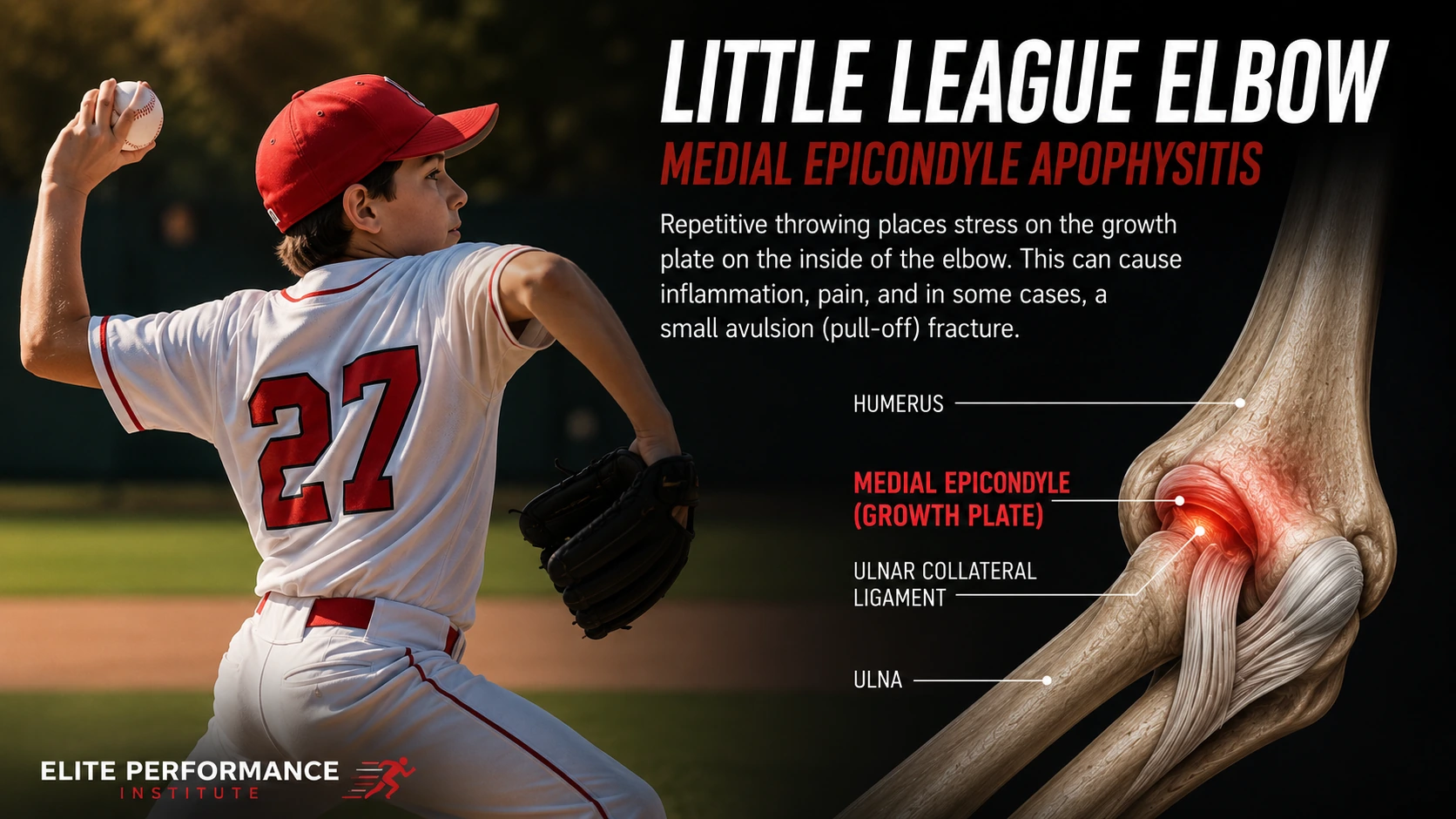
Little League elbow involves stress and irritation at the medial epicondyle growth plate on the inside of the throwing elbow.
Important distinction: Little League elbow is not the same condition as adult golfer’s elbow. The vulnerable structure in a skeletally immature athlete is often the developing growth plate, not simply the tendon.
What Causes Little League Elbow?
Little League elbow rarely comes from one single factor. It usually develops when several stressors overlap.
Throwing and Workload Factors
- High pitch or throw volume
- Throwing while fatigued
- Too little recovery between outings
- Rapid increases in throwing workload
- Year-round throwing without an offseason
- Playing on multiple teams at the same time
Athlete and Movement Factors
- Open growth plates and skeletal immaturity
- Recent growth spurts
- Reduced shoulder or thoracic mobility
- Limited hip mobility
- Poor trunk or single-leg control
- Inadequate strength for current throwing demands
Movement limitations do not automatically cause Little League elbow. However, inefficient force transfer may increase the amount of stress that reaches the arm. That is why a complete evaluation should consider the whole throwing athlete, not only the painful elbow.
Common Signs and Symptoms
Symptoms often begin gradually. A young athlete may initially notice discomfort only after throwing. Pain may then appear earlier as the condition progresses.
- Pain or soreness on the inside of the elbow
- Tenderness over the medial epicondyle
- Pain during or after throwing
- Loss of throwing velocity or distance
- Reduced accuracy or command
- Difficulty fully bending or straightening the elbow
- Symptoms that worsen during tournaments or high-volume weeks
- Trouble throwing on consecutive days
Do not encourage a young athlete to throw through elbow pain. Stop throwing and seek an evaluation when pain persists, affects motion, causes swelling, or repeatedly returns when the athlete resumes throwing. A sudden pop, significant swelling, or an inability to move the elbow warrants prompt medical attention.
Why Early Recognition Matters
Continued throwing can keep loading an irritated growth plate. This may prolong symptoms and delay the athlete’s return. In some cases, the problem can progress to a more significant growth-plate or avulsion injury.
Early care usually creates a much more manageable situation. The athlete can stop the aggravating activity, maintain fitness in other ways, begin appropriate rehabilitation, and address the workload factors that contributed to the problem.
Looking Beyond the Elbow
The elbow experiences the pain, but it is only one part of the throwing motion. Force begins at the ground and travels through the legs, hips, trunk, shoulder, elbow, wrist, and hand.
An evaluation may therefore include shoulder mobility, thoracic rotation, hip mobility, trunk control, lower-extremity strength, single-leg stability, and throwing workload. These findings help guide rehabilitation and make the return-to-throw process more specific to the athlete.
The goal is not to blame every elbow injury on the kinetic chain. The goal is to restore the elbow while also improving the athlete’s ability to handle and transfer force throughout the entire throwing motion.
What Does Treatment Look Like?
Most athletes begin with conservative care. The exact plan depends on symptom severity, examination findings, imaging when necessary, position, age, and time of year.
-
Stop painful throwing.
The athlete needs a period without throwing so the growth plate can settle. General conditioning may continue when it does not reproduce symptoms. -
Restore pain-free motion.
Rehabilitation works toward normal elbow, shoulder, and thoracic mobility without repeatedly irritating the injured area. -
Build strength and control.
The program may address the forearm, shoulder, scapula, trunk, hips, and lower body based on the athlete’s needs. -
Correct workload problems.
Parents, coaches, and clinicians should review pitch counts, throwing frequency, rest, team overlap, and recent workload spikes. -
Complete a structured return-to-throw program.
Throwing distance, effort, and volume should increase gradually. The athlete should not jump directly from rest into full practices or games.
Many athletes need an initial period away from throwing, followed by strengthening and a gradual throwing progression once they are pain-free. More severe cases may require a longer timeline, additional imaging, or referral to a sports medicine or orthopedic specialist.
When Can the Athlete Return to Throwing?
The calendar alone should not decide return to throwing. Before beginning a throwing program, the athlete should have pain-free daily activity, restored elbow motion, improving strength, and no tenderness that suggests the growth plate remains irritated.
A return-to-throw program usually begins with short, easy throws. Distance, volume, and intensity then progress in stages. If pain returns, the athlete should stop and have the plan reassessed.
Full participation should come only after the athlete tolerates the required throwing volume for their position without pain during the session or afterward.
Can Little League Elbow Be Prevented?
No strategy eliminates every injury. Still, parents and coaches can reduce avoidable throwing stress by following evidence-informed workload practices.
- Follow age-specific pitch-count and rest guidelines
- Track pitches across every team, not just one league
- Avoid pitching while fatigued or in pain
- Build throwing volume gradually after time off
- Schedule a true offseason from overhead throwing
- Avoid overlapping seasons and excessive showcase volume
- Maintain whole-body strength, mobility, and conditioning
- Communicate between parents, coaches, and healthcare providers
MLB and USA Baseball’s Pitch Smart guidelines provide age-based pitch limits, required rest, and offseason recommendations.
The Bottom Line
Little League elbow is common, but it should not be treated as a normal part of youth baseball or softball. Pain on the inside of a young athlete’s elbow is a sign that the current throwing demand may be exceeding the developing tissue’s capacity.
Most athletes do well with early recognition, a temporary break from throwing, progressive rehabilitation, better workload management, and a gradual return-to-throw plan. The process should restore the elbow while preparing the entire athlete for the demands of the sport.
Frequently Asked Questions About Little League Elbow
Can a young athlete keep playing if they stop pitching?
Not automatically. Many positions still require frequent overhand throwing. Participation depends on symptoms, examination findings, and whether the athlete can play without stressing the injured elbow.
Does Little League elbow require surgery?
Most cases respond to conservative care. Surgery may be considered for certain displaced avulsion fractures or other significant injuries, which is why an accurate diagnosis matters.
How long should an athlete rest from throwing?
The timeline varies. More significant cases may require longer than mild cases. A qualified healthcare professional should guide the return.
Can softball athletes develop Little League elbow?
Yes. The condition can affect skeletally immature softball athletes who perform frequent overhand throws, even though softball pitching mechanics differ from baseball pitching.
Should the athlete work on the shoulder, trunk, and hips?
Often, yes. Whole-body rehabilitation can improve strength and force transfer. It should complement appropriate management of the elbow rather than replace it.
Concerned About a Young Athlete’s Throwing Arm?
Elite Performance Institute provides sports rehabilitation and baseball and softball movement analysis for athletes in Naperville and the surrounding area. We look beyond the painful area to build a clear plan for recovery and return to sport.
This article is for general educational purposes and does not replace an individualized medical examination, diagnosis, or treatment plan.