
What Are the Best Running Shoes? What the Research Actually Says
One of the most common questions runners ask me is: What are the best running shoes?
My answer has been pretty consistent for years: for most runners, the best place to start is with a shoe that fits well and feels comfortable when you actually run in it.
That may sound overly simple in a world of gait scans, stability categories, carbon plates, rocker geometry, stack height, heel drop, and dozens of new shoe releases every year. But the research has moved much closer to that practical approach than to the older idea that every runner needs one specific shoe category based on foot type or pronation.
Quick answer: There is no single best running shoe for everyone. For most runners, start with a shoe that fits properly, feels comfortable while running, matches what you plan to use it for, and does not create symptoms. Comfort is an excellent starting point, but injury history, previous shoe experience, cushioning, support, heel drop, shoe rotation, and the type of running you are doing can all matter.
Is the Most Comfortable Running Shoe Usually the Best Choice?
Broadly speaking, I think that is a very reasonable way to choose a running shoe.
The idea has been described in footwear research as the comfort filter. Rather than assuming every runner needs to be forced into one ideal movement pattern, the comfort-filter concept proposes that runners tend to select footwear that allows them to move in a way that feels natural to their individual body.1
More recent research has made that idea even more interesting. In a 2025 analysis of 527 recreational runners followed for six months, runners who gave their study shoes the highest overall appreciation rating had a lower injury risk than runners who rated them lowest. Greater perceived cushioning was also associated with lower injury risk.2
That does not prove that comfort alone prevents injuries. It does suggest that how a shoe feels to the runner may be useful information rather than something we should ignore in favor of a complicated shoe-prescription formula.
My takeaway: If I put two reasonable running shoes on someone and one feels noticeably better while running, I place a lot of value on that. I do not need a computer to tell the runner that the shoe they dislike is somehow “better” for their body.
There Is No Universal “Best” Running Shoe
A 2022 Cochrane review compared neutral, cushioned, minimalist, motion-control, stability, soft-midsole, and hard-midsole shoes. Overall, the evidence that one category consistently prevents running injuries better than another was low or very low certainty. The review also found no evidence that prescribing shoes based solely on foot type reduces running-related injuries in adults.3
A review focused on footwear selection for runners reached a similar conclusion: there is not one proven shoe-selection paradigm that should dictate footwear for every runner. Comfort and individual preference remain important pieces of the decision.4
Start With Fit Before You Worry About Technology
- Your toes should have enough room and should not repeatedly hit the front of the shoe.
- The forefoot should not feel pinched or compressed.
- Your heel should feel reasonably secure without needing the shoe tied painfully tight.
- You should not immediately notice pressure points, rubbing, or numbness.
- The shoe should feel good while running, not simply while standing in a store.
Shoe shape matters too. Research has shown that toe-box geometry can change how the foot moves and deforms inside the shoe.5 That does not mean everyone needs the widest toe box possible. It means the shape of your foot and the shape of the shoe need to work reasonably well together.
Do Runners Need Shoes Based on Pronation?
Not automatically.
For years, runners were commonly placed into neutral, stability, or motion-control shoes based primarily on arch height or how much they pronated. The problem is that simply matching a shoe category to foot posture has not consistently reduced injuries.3
I also do not consider pronation inherently bad. Pronation is a normal part of running.
However, I would not swing the pendulum so far that we say support never matters. Research has found that certain runners, including some runners with more pronated foot posture, may benefit from motion-control footwear.6
What I Would Not Do
Watch someone pronate for 30 seconds and automatically tell them they need a stability or motion-control shoe for the rest of their running career.
What I Would Do
Consider support as one variable when the runner prefers it, has a relevant symptom history, or consistently feels and performs better in that type of shoe.
Does More Cushioning Reduce Running Injuries?
Cushioning is another area where simple rules tend to fall apart.
In a randomized trial of 848 recreational runners, runners assigned to a firmer shoe had a higher injury risk than those using a softer shoe. Interestingly, the protective effect of the softer shoe was seen primarily in lighter runners rather than heavier runners.7
Even more interesting, softer cushioning did not simply reduce every conventional impact-force measurement.8
To me, this is another reminder that the relationship between shoes, biomechanics, and injuries is much more complicated than “less impact equals fewer injuries.”
What About Heel-to-Toe Drop?
Heel-to-toe drop is the difference in height between the heel and forefoot of the shoe. You may see shoes advertised as 0 mm, 4 mm, 8 mm, 10 mm, 12 mm, and everything in between.
I do not think there is a universally ideal drop.
In a six-month randomized trial comparing shoes with different heel-to-toe drops, overall injury risk was not simply determined by one particular drop. Previous running experience and adaptation also appeared to matter.9
From a practical standpoint, lower-drop footwear generally shifts more demand toward the foot, ankle, calf, and Achilles complex, while higher-drop shoes can shift some demand proximally.
One thing I do care about is abrupt change. If you have spent years running comfortably in a 10–12 mm drop shoe, I would not suddenly replace every run with a zero-drop shoe because someone told you it is more “natural.” Give your body time to adapt whenever you make a meaningful change in footwear.
Are Minimalist Running Shoes Better?
Minimalist and barefoot running had a major surge in popularity, but the claim that everyone should be running in less shoe has not held up particularly well.
Minimalist footwear changes biomechanics and can increase demands at the ankle, foot, calf, and Achilles compared with more traditional footwear.10
That does not make minimalist shoes bad. Some runners love them and tolerate them extremely well. They simply are not universally superior.
Should You Rotate More Than One Pair of Running Shoes?
Yes—I generally like shoe rotation, especially for runners who run most days of the week.
One of the better-known studies on this topic followed 264 recreational runners for 22 weeks. Runners who used more than one pair of running shoes in parallel had a lower risk of running-related injury compared with runners who primarily used one pair.11
The reported adjusted hazard ratio was 0.61, which corresponds to approximately a 39% lower injury hazard in the multi-shoe group.
However, this was an observational study rather than a randomized trial. That means we cannot say that owning multiple shoes directly caused the lower injury rate.
The proposed explanation makes sense biomechanically: different shoes slightly change how load is distributed through the foot and lower extremity. Instead of exposing the exact same tissues to the exact same loading pattern on every run, rotating footwear may introduce some useful variation.
Do Running Shoes Need Time to Recover Between Runs?
There is also an interesting materials-science argument for allowing shoes some time between runs.
Running-shoe midsoles are made from foam materials that compress repeatedly while you run. Some of that deformation can recover after the shoe is unloaded.
In a mechanical-aging study of EVA running shoes, shoes that were allowed approximately 22 hours of rest between simulated running sessions demonstrated partial recovery in their ability to absorb energy when testing resumed.16
That supports the idea that running-shoe foam can recover to some degree after repeated loading.
However, I would be careful with the common statement that every running shoe requires exactly 24 or 48 hours to decompress. The research is not strong enough to establish one universal recovery time, especially because modern shoes use very different foam technologies.
An engineering study of Nike Pegasus Turbo II shoes found that much of the midsole shape recovery occurred within roughly 7–13 hours depending on the testing protocol, without showing a clear additional advantage from resting the shoes for multiple full days.17
My practical takeaway: Running-shoe midsoles do recover to some degree after loading, so alternating shoes is reasonable—particularly for runners training frequently. But I would not tell runners that every shoe scientifically requires exactly 48 hours before it can be worn again.
Do the Shoes in Your Rotation Have to Be Different?
No.
There are two perfectly reasonable approaches.
Different Shoe Models
For example, you could use a comfortable daily trainer for easy mileage and a lighter or more responsive shoe for workouts. This changes the footwear characteristics and potentially varies the loading pattern from one run to another.
Two Pairs of the Same Shoe
If you have found a shoe that you absolutely love, owning two pairs of that same model is completely reasonable. You can alternate the pairs while keeping the fit and ride that you already know works well for you.
If part of the potential benefit of rotation comes from changing musculoskeletal loading, two different models may theoretically provide more variation than two identical pairs.
But we do not have research showing that runners must rotate different brands or models.
I would rather have someone rotate between two pairs of a shoe they love than force them into another model they dislike simply because they think rotation has to mean completely different shoes.
A Simple Shoe Rotation Might Look Like This
- Easy and recovery runs: comfortable daily trainer
- Tempo or interval days: lighter trainer, super trainer, or workout shoe
- Race-specific workouts: occasional use of your planned race shoe
- Race day: super shoe if you have tested it and respond well to it
What About Carbon-Plated “Super Shoes”?
This is one area where the research on performance is much clearer than the research on injury prevention.
Advanced footwear technology—typically combining highly responsive foam, substantial stack height, rocker geometry, and a stiff plate—has repeatedly been shown to improve running economy and endurance performance.12
So if the question is, “Do super shoes help runners race faster?”, my answer is yes. The performance advantage is real.
Do Super Shoes Cause More Injuries if You Train in Them?
This is where I would be careful.
We do not currently have strong evidence showing that training in super shoes causes more injuries.
There have been legitimate concerns about altered foot and ankle loading, and a published case series described navicular bone-stress injuries in runners using carbon-plated footwear.13
But a case series cannot establish that the shoes caused those injuries.
More recent research has also found performance benefits from advanced footwear without systematically increasing the biomechanical variables examined that have been discussed in relation to running injury risk.14
So I would not tell runners that super shoes are dangerous for training.
How I Prefer to Use Super Shoes
Even without evidence that daily super-shoe use causes more injuries, I still prefer to think of racing shoes as a tool rather than the only shoe in your closet.
| Type of Run | My General Preference | Why |
|---|---|---|
| Easy / Recovery Run | Comfortable daily trainer | You do not need a racing shoe's performance advantage to accumulate comfortable easy mileage. |
| Tempo / Intervals | Trainer, super trainer, or super shoe | A faster shoe can be useful when pace and running economy matter. |
| Race-Specific Long Run | Super shoe can make sense | Useful for practicing race pace, fueling, race-day mechanics, and how the shoe feels when fatigued. |
| Race Day | Super shoe if comfortable and tested | This is where the performance advantage matters most. |
There is no reason you cannot do some training in a super shoe. I simply do not think most runners need to do every run in their racing shoe.
And I would not recommend buying a brand-new super shoe the week of a marathon and wearing it for 26.2 miles without testing it first.
Super Shoes and Super Trainers Are Not Exactly the Same Thing
The line between daily trainers and racing shoes has become increasingly blurry.
Many companies now make high-stack, responsive “super trainers” that borrow foam and geometry from racing shoes but are designed to be more stable and durable for regular training.
I am generally more comfortable with runners accumulating substantial training mileage in those shoes than in an ultra-light racing model designed primarily for competition.
What If You Have Always Run Well in the Same Shoe?
I place a lot of value on successful history.
If you have run thousands of healthy miles in the same model or same type of shoe, it feels comfortable, and you enjoy running in it, I need a pretty good reason to tell you that you suddenly need something completely different.
A gait analysis can provide useful information, but it should not override everything else we know about the runner.
Interestingly, a 2025 study found that simply telling runners that a shoe had been specifically matched to them through gait analysis altered their perceptions of comfort, expected performance, and injury protection—even when the shoes themselves were identical.15
Marketing and expectations are powerful. Your actual experience matters.
When Should You Replace Your Running Shoes?
You have probably heard that every running shoe needs to be replaced at exactly 300 or 500 miles.
I do not love using one universal mileage cutoff.
Shoe durability varies depending on the shoe, foam, running surface, runner, body size, mechanics, and how the shoe is used.
Instead of automatically throwing a shoe away at a certain mileage, pay attention to:
- How the shoe feels compared with when it was newer
- Visible outsole or midsole wear
- Loss of cushioning or responsiveness
- Changes in stability
- New discomfort that consistently occurs in the older shoe but not another pair
Mileage can be a useful reminder to inspect your shoes, but it should not necessarily be viewed as an automatic expiration date.
My Running Shoe Checklist
- Start with fit. Make sure there is adequate toe room, a secure heel, and no obvious pressure points.
- Run in the shoe. Walking around a store is not the same as running.
- Choose the shoe that feels comfortable. Comfort is useful information.
- Match the shoe to the job. Daily training, speed work, trails, and racing do not necessarily need the same shoe.
- Consider your history. Previous injuries and shoes you have successfully tolerated matter.
- Use support when it helps you. Pronation alone should not determine your shoe.
- Do not obsess over heel drop. There is no universally perfect number.
- Rotate shoes if it fits your training. That may mean multiple models or simply two pairs of the same shoe you already love.
- Transition gradually when making a major change. This is particularly important with minimalist, zero-drop, or carbon-plated footwear.
- Use super shoes strategically. They are excellent performance tools, but most runners do not need them for every easy run.
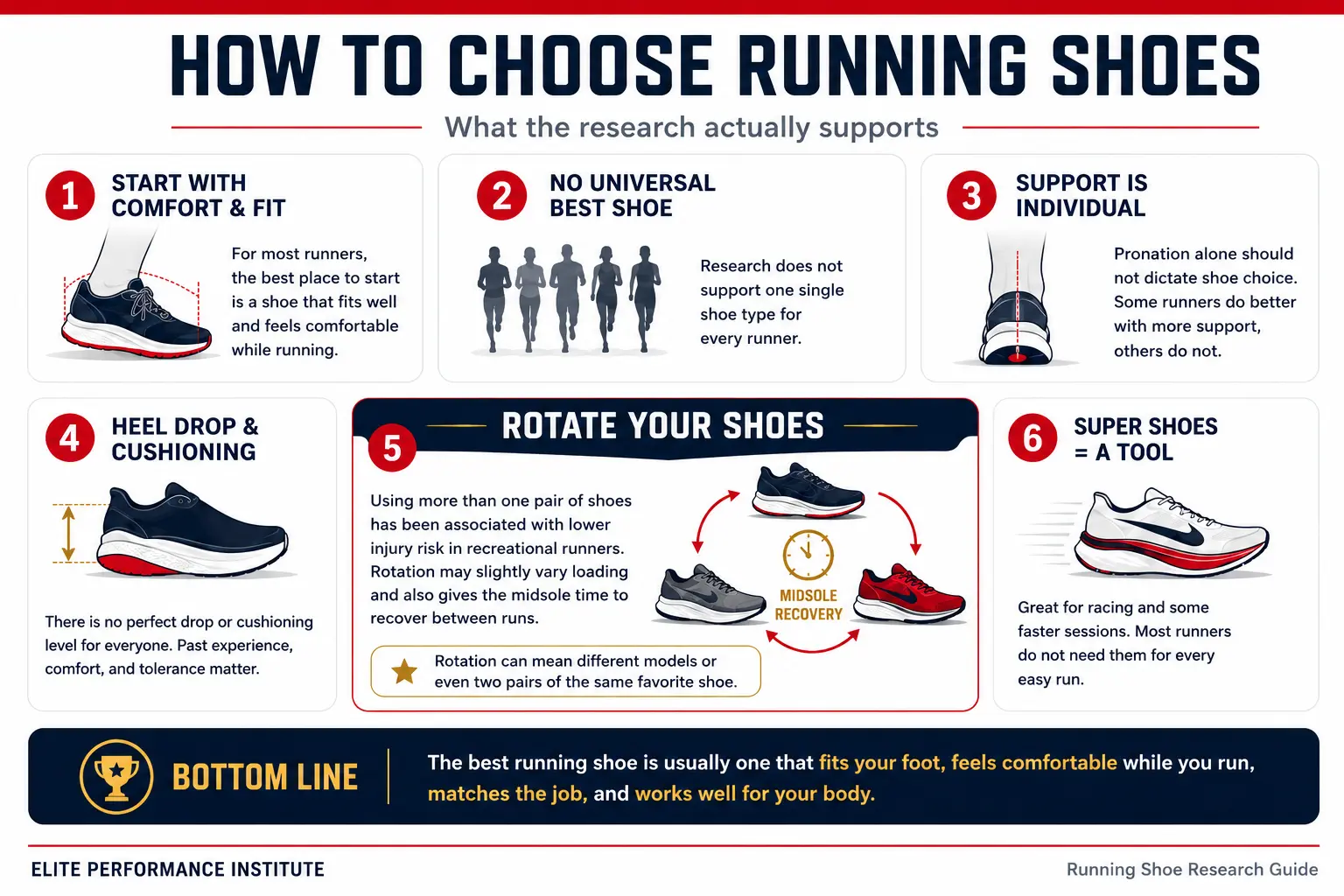
There is no universal best running shoe. Start with fit and comfort, consider how you plan to use the shoe, and rotate footwear when it makes sense for your training.
So, What Is the Best Running Shoe?
The best running shoe is usually one that fits your foot, feels comfortable while you run, matches the type of running you are doing, and has a track record of working well for your body.
No amount of marketing can make one shoe universally best.
Some runners love a soft max-cushioned shoe. Others hate it. Some runners feel great in stability shoes. Others prefer neutral shoes. Some thrive in low-drop footwear. Others immediately feel more demand through the calves and Achilles.
Some runners receive a large performance benefit from one particular super shoe while another runner prefers a completely different model.
That individual variation is normal.
The goal should not be to find the shoe the internet says is best.
The goal is to find the shoe—or shoes—that work best for you.
Frequently Asked Questions About Running Shoes
Is the most comfortable running shoe usually the best?
Comfort is one of the best starting points we currently have. It should not be the only consideration, but a shoe that fits well and feels good while running is generally a reasonable choice for most runners.
Do I need a stability shoe if I pronate?
Not necessarily. Pronation is normal and foot posture alone should not dictate your shoe. However, some runners may benefit from stability or motion-control features.
Is more cushioning always better?
No. Softer cushioning has reduced injury risk in some research, but individual responses vary considerably.
What heel drop should I run in?
There is no universally ideal heel-to-toe drop. Previous footwear, injury history, comfort, and adaptation matter more than chasing one specific number.
Should runners rotate shoes?
Shoe rotation is reasonable. Observational research has associated the use of multiple shoes with lower injury risk. Using different models may vary how the body is loaded, while alternating two pairs of the same favorite shoe is also a practical option.
Do running shoes need 48 hours to decompress?
Running-shoe foam can partially recover after repeated loading, but research does not establish a universal 48-hour rule. Recovery depends on the foam, shoe, amount of loading, and testing method.
Should I train in carbon-plated super shoes?
You can. There is not strong evidence showing that training in super shoes inherently causes more injuries. I generally prefer using them selectively for faster or race-specific workouts and racing rather than making them the only shoe you run in.
Do I have to rotate different shoe models?
No. Rotating different shoes can provide more variation in footwear characteristics, but two pairs of the same shoe can also be a perfectly reasonable option for someone who has found a model that works very well.
References
- Nigg BM, Baltich J, Hoerzer S, Enders H. Running shoes and running injuries: mythbusting and a proposal for two new paradigms: preferred movement path and comfort filter. Br J Sports Med. 2015.
- Association of Shoe Cushioning Perception and Comfort With Injury Risk in Leisure-Time Runners. 2025.
- Relph N, et al. Running shoes for preventing lower limb running injuries in adults. Cochrane Database Syst Rev. 2022.
- Running Injury Paradigms and Their Influence on Footwear Design Features and Runner Assessment Methods. 2022.
- Zhu C, et al. Toe Box Shape of Running Shoes Affects In-Shoe Foot Displacement and Deformation. 2024.
- Malisoux L, et al. Injury risk in runners using standard or motion control shoes. 2016.
- Malisoux L, et al. Shoe Cushioning Influences the Running Injury Risk According to Body Mass. 2020.
- Malisoux L, et al. Effect of shoe cushioning on landing impact forces and spatiotemporal parameters during running. 2021.
- Malisoux L, et al. Influence of the Heel-to-Toe Drop of Standard Cushioned Running Shoes on Injury Risk. 2016.
- Sun X, et al. Systematic Review of the Role of Footwear Constructions in Running Biomechanics. 2020.
- Malisoux L, et al. Can parallel use of different running shoes decrease running-related injury risk? Scand J Med Sci Sports. 2015.
- Xiao Y, et al. Effects of Advanced Footwear Technology on Running Economy and Endurance Performance. 2026.
- Tenforde AS, et al. Bone Stress Injuries in Runners Using Carbon Fiber Plate Footwear. 2023.
- Wang W, et al. Effects of Advanced Footwear Technology on Running Economy and Biomechanical Risk. 2026.
- Fife A, et al. Running Shoe Recommendations Based on Gait Analysis Improve Perceptions of Comfort, Performance and Injury Risk. 2025.
- Allen T, Pagan M, Martin R, Duncan O. Effect of Rest Periods on Mechanical Ageing of Running Shoes. Proceedings. 2020;49(1):138.
- Hagen EB. Recovery Effects on the Performance of Athletic Shoes. Master's thesis, Grand Valley State University. 2021.
Still Unsure Which Running Shoe Makes Sense for You?
If you are dealing with recurring pain, changing shoes after an injury, or simply want a closer look at how your footwear fits into your running mechanics and training, a running analysis can help put the shoe question into context.
This article is for general educational purposes and is not medical advice. Running-shoe selection should be individualized when pain, injury, medical conditions, or other specific concerns are present.