
The Throw Doesn’t End When the Ball Leaves Your Hand: Why the Follow-Through Matters
Watch a young athlete throw a baseball or softball and it is easy to focus on the moment the ball leaves the hand.
Was the arm in the right position? Did they release the ball out front? How fast did they throw?
But there is another part of the throw that deserves attention: what happens after the ball is released.
The follow-through is not simply the final position of a throw. It is part of how the body continues moving and decelerating after the arm has accelerated toward the target. For baseball and softball athletes, the way the hips, trunk, and arm continue through the throw can provide useful information about how the athlete is using the entire kinetic chain.
Quick answer: A good throwing follow-through is not about forcing an athlete into one picture-perfect finishing position. The hips, pelvis, trunk, shoulder, and arm should have enough mobility and control to continue moving after release and safely complete the throw. When the lower body or trunk stops contributing, the athlete may rely more heavily on the arm to finish the motion.
What Is a Throwing Follow-Through?
The follow-through is the portion of the throwing motion that occurs after the ball leaves the hand.
At release, the body does not suddenly stop. The trunk continues moving, the throwing arm travels across the body, and the lower body continues to contribute to the movement.
That continuation matters because throwing involves rapid acceleration followed by an equally important need to slow the body down. The athlete has to create force, transfer that force through multiple body segments, deliver the ball, and then control the momentum that remains after release.
The key idea: the follow-through is not something added onto the throw at the end. It is the continuation of the same kinetic-chain sequence that created the throw in the first place.
Why Do the Hips Matter During Throwing?
The hips are an important link between the lower body and upper body. A coordinated throw begins from the ground and progresses through the legs, pelvis, trunk, shoulder, and arm. The hips help the pelvis rotate and allow the trunk to continue moving toward the target.
Research in collegiate baseball pitchers has found associations between hip rotational range of motion and several parts of pitching mechanics, including trunk rotation velocity, maximum shoulder external rotation, and elbow position at ball release.1
That does not mean every athlete needs the same amount of hip rotation. It also does not mean limited hip mobility automatically causes an elbow or shoulder injury.
It does reinforce a concept we use frequently when working with throwing athletes: the arm is only one part of the system. What happens at the hips can influence how the rest of the body completes the throw.
This is similar to the role of the thoracic spine that we discussed in The Hidden Reason You’re Losing Power in Baseball & Softball. Efficient throwing depends on multiple regions contributing at the right time rather than asking one area to do everything.
What Happens When the Hips Don’t Continue Through?
Imagine an athlete who starts the throw with the lower body but then essentially stops rotating the pelvis and trunk while the throwing arm continues aggressively toward the target.
The arm still has to finish the throw.
That does not automatically mean the athlete will get injured. However, it may change how motion and force are distributed throughout the kinetic chain.
In the collegiate pitching study mentioned above, hip rotational range of motion was associated with trunk and upper-extremity kinematics related to pitching performance and medial elbow loading.1 The study was small, so the findings should be interpreted as relationships rather than proof that one hip restriction directly causes one arm problem.
Research in younger athletes adds another useful perspective. A longitudinal cohort study of 8- and 9-year-old baseball pitchers identified insufficient pelvic rotation during pitching as a potential risk factor for future shoulder and elbow throwing injuries.2
Again, that is an association—not proof that limited pelvic rotation directly causes injury. Throwing injuries are multifactorial, and workload, recovery, growth, strength, mobility, mechanics, and other factors all matter.
Common Things We Look for in the Follow-Through
When evaluating a baseball or softball athlete, there are several findings that may make us look more closely at the hips, trunk, balance, and follow-through:
- Limited pelvic rotation toward the target
- An abrupt or shortened follow-through
- The trunk appearing to stop while the arm continues
- Difficulty maintaining balance after the throw
- Excessive visible arm effort to create distance or velocity
- Limited hip rotation on one or both sides
- A noticeable side-to-side difference during movement testing
None of these findings automatically means the athlete has “bad mechanics.” They are simply pieces of information that help us understand how the athlete creates, transfers, and controls force.
Looking Beyond the Arm
One of the biggest mistakes in throwing analysis is focusing exclusively on the arm. The arm is the final link in a much larger movement sequence.
Before Ball Release
The legs create a foundation, the hips and pelvis contribute to rotation, and the trunk helps transfer that movement toward the throwing arm.
After Ball Release
The trunk, shoulder, arm, and lower body continue moving as the athlete completes the throw and decelerates the body.
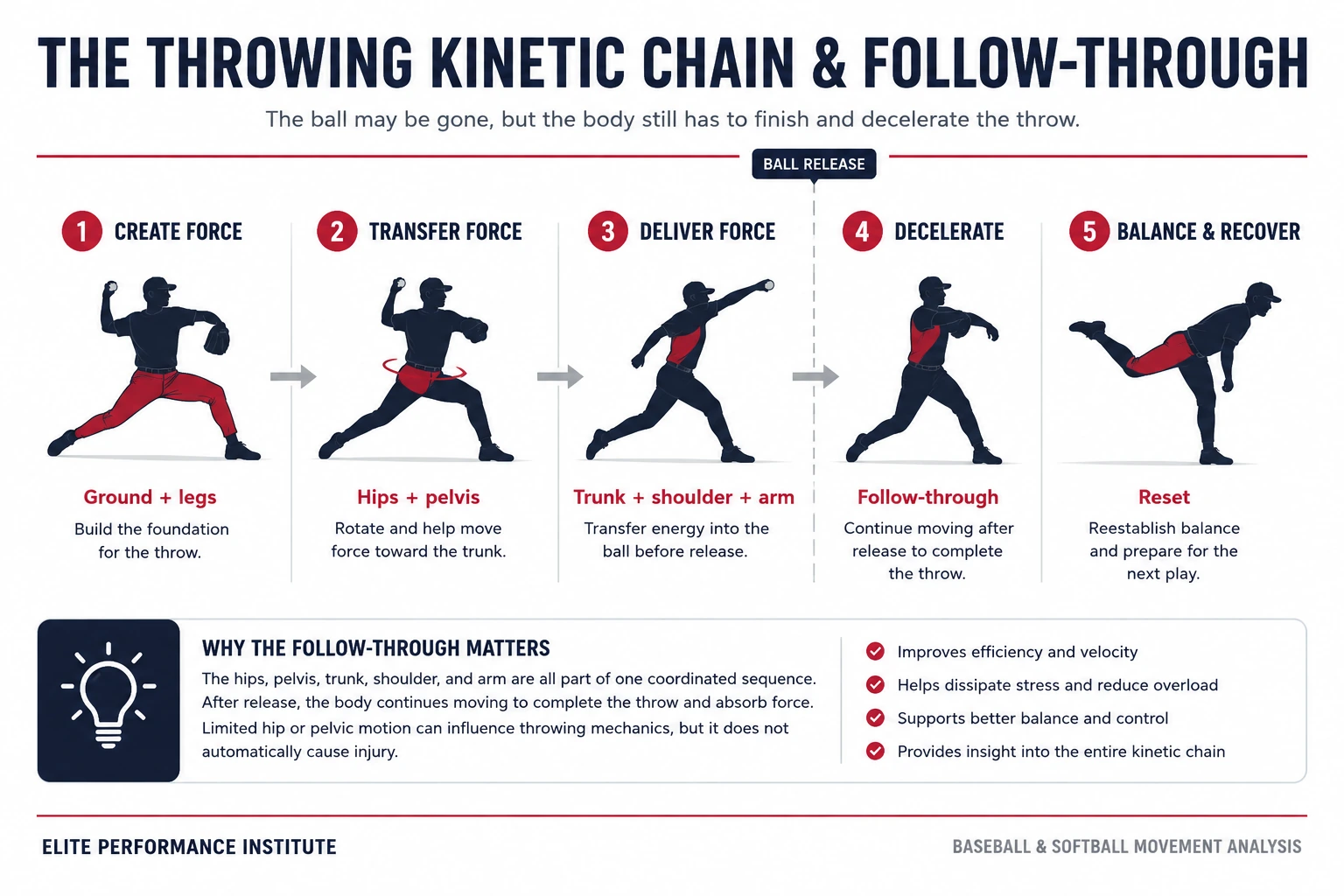
The throwing motion is a coordinated kinetic chain that continues through the follow-through after ball release.
The follow-through gives us another window into what happened earlier in the movement. If an athlete consistently struggles to rotate through the hips or trunk, the next question should not simply be, “How do we make them finish more?”
Instead, we want to know why they are using that movement strategy.
- Is there a hip mobility limitation?
- Is thoracic rotation limited?
- Is the athlete struggling with single-leg balance?
- Is there a strength or trunk-control deficit?
- Is the timing or sequencing of the movement off?
- Or is the athlete simply using a strategy that works well for their position and skill level?
A throwing video can show us what happened. A broader movement assessment can help explain why it may be happening.
How We Evaluate the Follow-Through
At Elite Performance Institute, we do not evaluate the follow-through in isolation. During a Baseball & Softball Movement Analysis, we can compare what is seen on throwing or hitting video with the athlete’s mobility, strength, and movement capacity.
Mobility
Hip rotation, thoracic rotation, shoulder mobility, and other ranges needed during the throw.
Control
Single-leg stability, trunk control, rotational control, and the ability to own the positions the athlete moves through.
Video
How those physical findings relate to what is actually happening during the athlete’s throw.
For example, if an athlete demonstrates limited hip rotation during an assessment and also shows limited pelvic rotation during throwing, those findings provide more useful information than simply telling the athlete to “finish better.”
The goal is not to force a particular follow-through. The goal is to determine whether the athlete has the mobility, strength, control, and coordination necessary to move efficiently through the entire throwing motion.
Can the Throwing Follow-Through Be Improved?
Yes, but the answer is not necessarily to tell an athlete to “follow through more.”
If the athlete does not have the mobility or control required to rotate through the hips and trunk, forcing a larger finish may not address the actual limitation.
Training should instead focus on the factor that appears to be limiting the movement. Depending on the athlete, that may include:
- Improving hip rotational mobility
- Developing thoracic rotation
- Improving single-leg stability
- Building rotational strength
- Developing trunk control
- Improving shoulder mobility or control when needed
- Practicing throwing-specific movement with the athlete’s coach
The goal is to build the physical capacity to complete the motion naturally rather than forcing the athlete into a position they cannot control.
Can Better Hip Rotation Prevent Arm Injuries?
This is where it is important to be precise.
Research supports relationships between hip and pelvic mechanics and shoulder or elbow biomechanics, and insufficient pelvic rotation has been identified as a potential risk factor in young baseball players.1,2
However, we cannot say that improving hip rotation will prevent a rotator cuff injury, Little League Elbow, or another throwing injury.
Throwing injuries are multifactorial. Workload, recovery, age, growth, strength, mobility, mechanics, throwing volume, and many other factors can contribute.
Think of hip and pelvic motion as one part of the picture. Evaluating the hips gives us another opportunity to identify factors that may influence the way an athlete creates and transfers force, but it should never replace workload management, recovery, appropriate strength training, or a complete evaluation when pain is present.
If an athlete is dealing with recurring arm discomfort, our Baseball Arm Care and Throwing Athlete Shoulder Pain pages explain more about how we evaluate throwing-related symptoms beyond the painful area.
The Bottom Line
A throw does not end when the ball leaves the hand.
The follow-through is part of the body’s ability to continue moving and control the forces created during the throw. The hips and pelvis are important pieces of that sequence because they help connect the lower body with the trunk and upper extremity.
Limited hip or pelvic motion does not automatically mean an injury is coming. However, when an athlete consistently struggles to rotate through the lower body, it is worth understanding what may be limiting the movement and how the rest of the kinetic chain responds.
The goal is not to create a picture-perfect finish. It is to help baseball and softball athletes develop the mobility, strength, control, and coordination needed to efficiently create, transfer, and absorb force throughout the entire throwing motion.
Sometimes that means looking beyond the arm—and the hips may be a good place to start.
Frequently Asked Questions
Why is follow-through important when throwing?
The follow-through allows the body to continue moving after ball release rather than stopping abruptly. It is part of the athlete’s overall strategy for completing and decelerating the throwing motion.
Does hip rotation affect throwing mechanics?
It can. Research has found associations between hip rotational range of motion and trunk, shoulder, and elbow-related pitching variables. That does not mean one specific hip range is required for every athlete.
Should a pitcher be told to follow through more?
Not automatically. If the athlete lacks the mobility, balance, strength, or control needed to complete the movement, simply forcing a larger finish may not solve the underlying issue.
Can limited hip rotation cause elbow or shoulder injuries?
Limited hip or pelvic motion may influence throwing mechanics, but injury is multifactorial. Current research supports associations and potential risk factors rather than a simple cause-and-effect relationship.
What does a Baseball & Softball Movement Analysis look at?
The assessment can include hip mobility, thoracic rotation, shoulder mobility, single-leg stability, trunk control, strength, and video review of throwing or hitting.
References
- Zeppieri G Jr, Bruner ML, Michelini JP, Farmer KW. The Relationship Between Hip Range of Motion and Pitching Kinematics Related to Increased Elbow Valgus Loads in Collegiate Baseball Pitchers: A Pilot Study. Int J Sports Phys Ther. 2021;16(2):468-476. doi:10.26603/001c.21319.
- Risk factors of throwing injuries related to pitching mechanics in young baseball players: a longitudinal cohort study. J Shoulder Elbow Surg. 2023. doi:10.1016/j.jse.2023.07.009.
Want a Closer Look at How Your Athlete Moves?
Our Baseball & Softball Movement Analysis combines video review with mobility, strength, stability, and movement testing. The goal is to understand the body behind the throw and give the athlete a practical plan based on what we actually find.
This article is for general educational purposes and does not replace an individualized medical examination, diagnosis, treatment plan, or sport-specific instruction from a qualified coach.