
What Is the Rotator Cuff? A Parent’s Guide for Baseball & Softball Athletes
Whether you are watching your child’s Little League game or a professional baseball broadcast, you have probably heard someone mention the rotator cuff.
“Hopefully it is not a rotator cuff injury.” “They need to strengthen the rotator cuff.” “That must be what is causing the shoulder pain.”
The rotator cuff is one of the most recognized parts of the shoulder, but it is also one of the most misunderstood. Many people think its main job is to create throwing power. In reality, the rotator cuff acts more like the shoulder’s built-in stabilization system. It helps keep the ball of the upper arm centered in the socket while the rest of the body creates and transfers force.1,2
Quick answer: The rotator cuff is a group of four muscles and their tendons that move and stabilize the shoulder. During throwing, these muscles help control the humeral head, support the shoulder through high-speed motion, and help slow the arm after the ball is released.
What Is the Rotator Cuff?
The shoulder is a ball-and-socket joint. The rounded head of the humerus, or upper arm bone, sits within a shallow socket in the shoulder blade called the glenoid.
The rotator cuff consists of four muscles that begin on the shoulder blade and connect to the upper arm through their tendons. Together, these tendons form a cuff around the humeral head. The muscles help lift and rotate the arm while dynamically stabilizing the shoulder joint.1
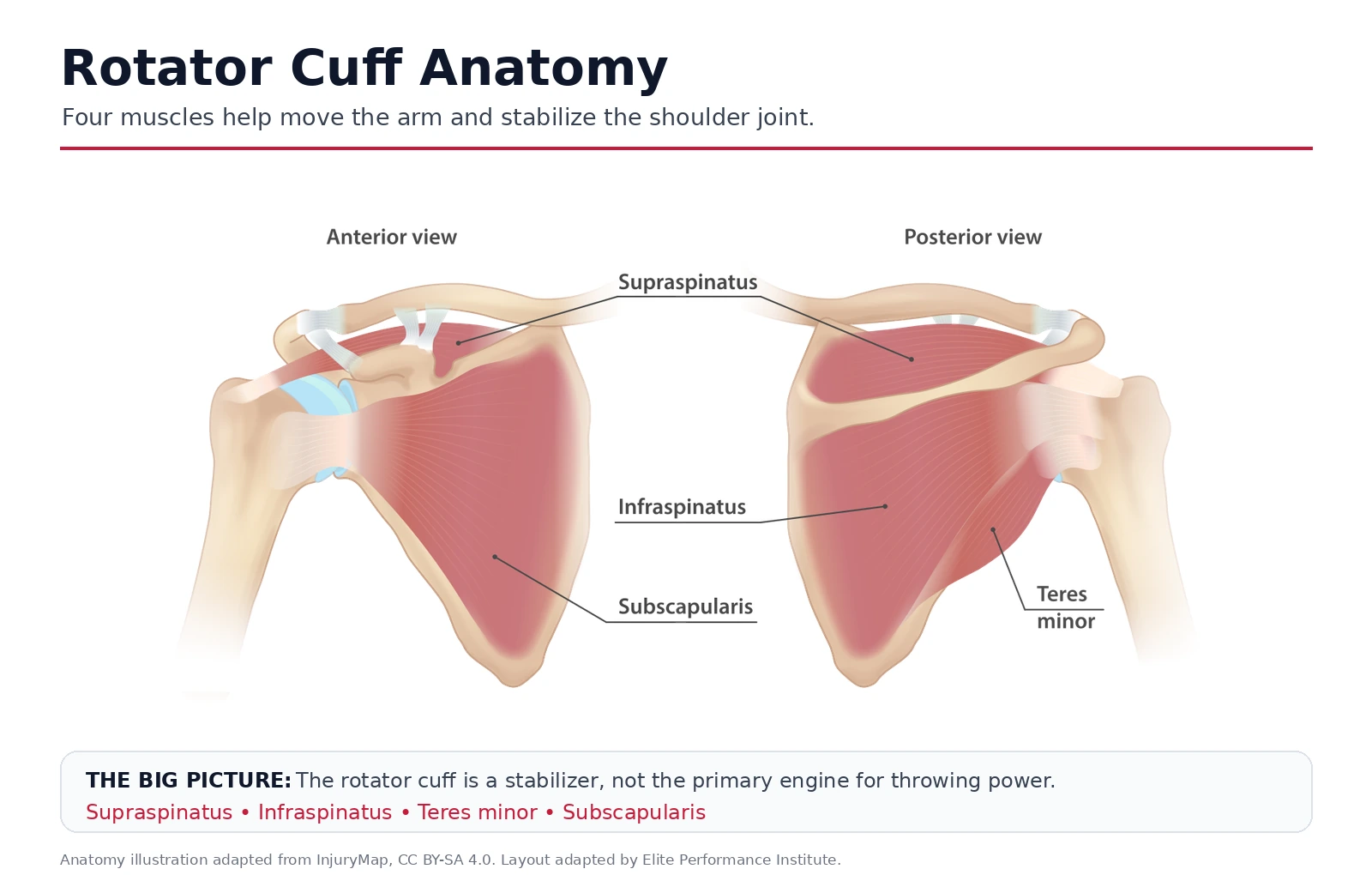
The rotator cuff includes the supraspinatus, infraspinatus, teres minor, and subscapularis. Anatomy illustration adapted from InjuryMap under CC BY-SA 4.0.
The Four Rotator Cuff Muscles
| Muscle | Primary Role | Why It Matters for Throwing |
|---|---|---|
| Supraspinatus | Assists with lifting the arm and compresses the humeral head into the socket. | Helps support the shoulder as the arm moves into and through overhead positions. |
| Infraspinatus | Externally rotates the arm and contributes to shoulder stability. | Helps control the arm during cocking and plays an important role in deceleration. |
| Teres Minor | Assists with external rotation and dynamic stabilization. | Works with the infraspinatus to control the humeral head during high-speed throwing. |
| Subscapularis | Internally rotates the arm and stabilizes the front of the shoulder. | Contributes during acceleration while helping keep the humeral head centered. |
Each muscle has a slightly different role, but they function as a team. That is why “training the rotator cuff” should not mean performing one band exercise forever. A complete shoulder program should account for rotation, stability, shoulder-blade control, endurance, and the demands of the athlete’s position.
What Does the Rotator Cuff Do During Throwing?
Throwing a baseball or softball is one of the fastest movements in sports. Force begins at the ground, travels through the legs and hips, moves through the trunk and shoulder blade, and eventually reaches the arm and ball.
The rotator cuff is not the main engine creating that force. Instead, it helps manage the shoulder as force passes through the arm.
A simple way to think about it: the legs and trunk help create and transfer power, while the rotator cuff helps keep the shoulder controlled enough to use that power.
Why Is the Rotator Cuff Important for Young Athletes?
Young baseball and softball athletes may throw hundreds of times during a week when warm-ups, practices, games, bullpens, lessons, and multiple teams are all included.
As throwing volume increases, so does the demand placed on the shoulder. Fatigue can reduce how effectively the rotator cuff and shoulder-blade muscles control the joint. Rapid workload increases, inadequate recovery, and periods of growth can make managing those demands more difficult.
This does not mean every young athlete with shoulder pain has a rotator cuff injury. Youth throwing pain can involve several structures, and symptoms should be evaluated rather than diagnosed based on a single muscle group or internet checklist.
The Rotator Cuff Does Not Work Alone
One of the biggest misconceptions about throwing is that shoulder health depends only on the shoulder. Throwing is a coordinated, full-body movement.
- The legs help create force from the ground.
- The hips and trunk help transfer that force.
- The thoracic spine allows the upper body to rotate.
- The shoulder blade provides a moving foundation for the arm.
- The rotator cuff helps keep the shoulder centered and controlled.
When one part of that system contributes less effectively, another area may have to absorb more stress. That is why evaluation and training for throwing athletes often include the hips, trunk, thoracic spine, shoulder blade, and throwing workload—not only the rotator cuff.4,5
For more on this concept, read The Hidden Reason You’re Losing Power in Baseball & Softball.
Does My Child Need to Strengthen the Rotator Cuff?
Rotator cuff strength and endurance are important, but shoulder health involves more than isolated band work.
- Appropriate throwing volume and pitch counts
- Adequate recovery between throwing sessions
- Shoulder-blade strength and control
- Thoracic mobility and trunk control
- Hip and lower-body strength
- A progressive strength and conditioning program
- A gradual warm-up before high-intensity throwing
Youth arm-care programs commonly include rotator cuff loading, scapular exercises, trunk control, lower-body work, and coordination rather than treating the shoulder as an isolated body part.4
Explore the Shoulder Exercise Library
Elite Performance Institute’s free shoulder exercise library includes rotator cuff exercises, external rotation drills, scapular control work, serratus exercises, isometrics, and overhead stability progressions.
Exercises should be selected based on the athlete’s age, symptoms, current capacity, and throwing demands. A random list of shoulder drills is not a substitute for an individualized evaluation when pain is present.
View Shoulder Exercise LibraryWhen Should Parents Be Concerned?
It is normal for an athlete to feel generally tired after throwing, especially during a busy part of the season. Pain, however, should not be treated as something a young athlete must push through.
- Pain during throwing
- Pain that continues after practices or games
- Reduced velocity or throwing distance
- Loss of accuracy or command
- Difficulty making routine throws
- Pain that changes the athlete’s mechanics
- Night pain, noticeable weakness, or loss of motion
- Symptoms that continue to worsen over time
Do not try to diagnose every throwing-related shoulder problem as a rotator cuff injury. Persistent pain, weakness, loss of motion, or a sudden injury deserves an appropriate healthcare evaluation.
The Bottom Line
The rotator cuff is a group of four muscles and their tendons that help move and dynamically stabilize the shoulder. Its main role during throwing is not to create all of the power. It helps keep the shoulder controlled while the rest of the body generates and transfers force.
For young baseball and softball athletes, a healthy shoulder depends on more than one group of muscles. Workload, recovery, shoulder-blade control, thoracic mobility, trunk and hip strength, and overall physical preparation all matter.
Understanding the true role of the rotator cuff can help parents move beyond vague advice to “strengthen the arm” and better appreciate what healthy throwing preparation actually involves.
Frequently Asked Questions About the Rotator Cuff
How many muscles are in the rotator cuff?
Four: the supraspinatus, infraspinatus, teres minor, and subscapularis.
Does the rotator cuff create throwing velocity?
It contributes to shoulder motion, but most throwing force comes from the coordinated kinetic chain. The rotator cuff’s major role is to stabilize and control the shoulder while that force moves through the arm.
Is shoulder pain in a young athlete always a rotator cuff problem?
No. Shoulder pain may involve growth plates, tendons, the labrum, shoulder-blade mechanics, workload, mobility, or other factors. Persistent symptoms deserve an evaluation.
Are band exercises enough for a throwing athlete?
Not by themselves. A complete program should also consider scapular control, trunk and hip strength, mobility, workload, recovery, and throwing preparation.
Should an athlete throw through shoulder pain?
No. Pain that occurs during throwing, changes mechanics, or continues afterward should be addressed rather than ignored.
References
- American Academy of Orthopaedic Surgeons. Rotator Cuff Tears: Frequently Asked Questions.
- American Academy of Orthopaedic Surgeons. Shoulder Injuries in the Throwing Athlete.
- Escamilla RF, Yamashiro K, Paulos L, Andrews JR. Shoulder muscle activity and function in common shoulder rehabilitation exercises. Sports Med. 2009;39(8):663-685. doi:10.2165/00007256-200939080-00004.
- Wilk KE, Lupowitz LG, Arrigo CA. The Youth Throwers Ten Exercise Program. Int J Sports Phys Ther. 2021;16(6):1387-1395.
- Mayes M, Salesky M, Lansdown DA. Throwing Injury Prevention Strategies With a Whole Kinetic Chain-Focused Approach. Curr Rev Musculoskelet Med. 2022;15:53-64.
Concerned About a Throwing Athlete’s Shoulder?
Elite Performance Institute evaluates shoulder mobility, rotator cuff and scapular strength, thoracic rotation, hip and trunk control, workload, and the demands of the athlete’s position. The goal is to understand the athlete behind the throwing motion and build a clear plan.
This article is for general educational purposes and does not replace an individualized medical examination, diagnosis, or treatment plan.