Set up today’s session.
Choose the prescribed day and available variations. Where the plan allows a set or round range, choose before starting; that choice stays fixed for the session.

A self-guided, four-phase runner’s knee program with guided strength circuits, exercise videos, and private workout history. Follow the plan and record your training response.
Guided sessions
Follow the prescribed day, exercise order, and demonstrations.
Private workout history
Record load, reps/time, effort, and exercise notes.
A complete four-phase framework
Progression criteria, running guidance, and maintenance stay together.
Self-guided educational program. No subscription. Individualized diagnosis, monitoring, and treatment are not included.
INSIDE YOUR MEMBER ACCOUNT
Your program includes a guided workout journal alongside the lessons and progress tracker. Follow each step, log your session, and see your previous recorded values when you repeat an exercise.
See the four-phase plan ↓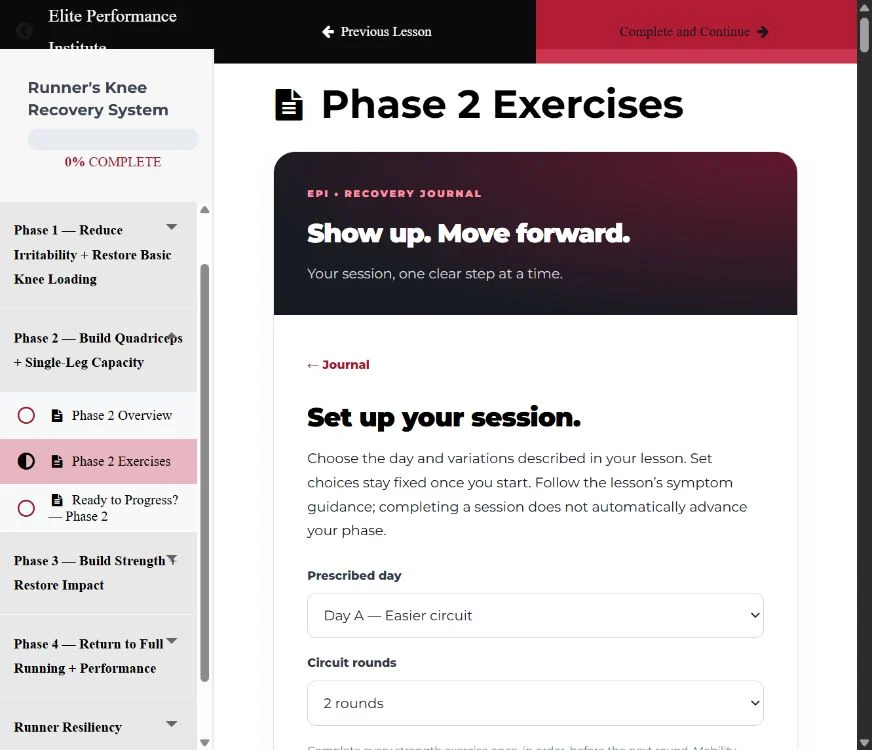
Choose the prescribed day and available variations. Where the plan allows a set or round range, choose before starting; that choice stays fixed for the session.
Follow the exercise order and demonstrations. Record load or resistance, actual reps/time, effort (RPE), and an optional note for each exercise.
Drafts autosave for refresh and resume. Completed sessions appear in your private history alongside progress check-ins. Previous exercise entries are a reference for your next session.
For your own tracking. Entries are not monitored, and saving does not request feedback or individualized care. Workout history sits alongside your symptom check-ins; it does not automatically advance your rehab phase.
A Better Way to Approach Rehab
Patellofemoral pain often becomes frustrating when squats, stairs, and running keep aggravating the knee—but an endless list of isolated exercises does not create a usable progression.
The Runner’s Knee Recovery System addresses the decisions that matter: how much knee loading is tolerable, when to increase strength and single-leg demand, when impact is appropriate, and how to build running without piling on hills and speed too quickly.
Each phase includes a clear objective, exercise demonstrations, starting doses, symptom monitoring and readiness criteria.
Who This Program Is For
This course targets common pain mainly around or behind the kneecap that is sensitive to running, squatting, stairs, or other knee-bending loads.
Two Foundations. One Recovery System.
The course addresses two demands at once: modifying provoking running exposure and progressively restoring quadriceps and single-leg strength.
Build activity around a conservative symptom-response rule instead of automatically stopping every run.
Short A/B circuits begin with comfortable quadriceps and hip exercises, then progress toward split squats or skater squats, supported by glute, calf, and tibialis strength.
These are educational principles, not a home diagnostic test. Other knee conditions require different assessment and care.
The Recovery System
Strength progresses through four phases, while running is guided by current tolerance. Your next step depends on your response—not a fixed number of weeks.
Alternate short A/B circuits with a wall sit or quad isometric, lateral-hip work, hamstring, calf, and tibialis exercises.
Pair an easier isometric circuit with a harder split-squat session, progressively adjusting depth, control, and resistance.
Keep the easier isometric day; progress split squats or skater squats, lateral-hip work, weighted calf and glute strength, and short pogo bouts.
Maintain strength and gradually restore desired training demands, including long runs, hills and faster running when tolerated.
Everything Included
Every part of the program is designed to make the next decision clearer, from your first lesson through your return to normal training.
Learn the patellofemoral pain pattern, monitor symptoms, and choose an appropriate running starting point.
Follow the prescribed session in order with exercise demonstrations and dosing. Record your actual load/resistance, reps/time, effort, and exercise notes in the private workout journal.
Use phase-specific strength and impact checkpoints to decide when to progress; running has its own symptom-based plan.
Already running? Adjust the dose as needed. Been off running? Follow a stepwise 5–25-minute restart, frequency build, and gradual return to workouts.
Choose optional balance, adductor or core work in three levels without repeating exercises already in your main A/B routine.
Household equipment, Swiss ball, weights, and substitutions for later strength/impact phases.
Answers about stairs, squats, symptom flares, running modifications, equipment and maintenance.
Read the patellofemoral pain best-practice guideline and runner-specific load-management research.
Personal Progress Dashboard
Your course includes a private Runner’s Knee progress tracker so you can follow knee symptoms, strength and running trends across weeks.
Log strength phase and running stage separately, along with knee symptoms, running minutes, optional cadence, and strength progress.
Example dashboard for illustration only.
Return to Running
Running doesn’t need to be paused automatically. Some runners can continue at a tolerable level while strengthening; others benefit from a structured restart after time away.
Our approach combines research-based runner symptom monitoring with progressive knee strength and 18 years coaching track and field athletes.
If you have stopped running, follow the 5 → 10 → 15 → 20 → 25-minute easy-running progression with non-running days between steps.
Restore normal easy duration and distance before increasing hills or speed.
Progress long runs, downhills, tempo/threshold, intervals and speed as response allows.
Running and strength progress on separate tracks. Manage pain during a run, recovery afterward and the next morning; progress only when that response stays stable.
Why the Program Is Built This Way
The course reflects the 2024 patellofemoral pain best-practice guide, the 2019 clinical practice guideline, runner-specific load-management trials, and evidence on selective gait retraining.
Research defines the core principles; EPI organizes them into practical training decisions, A/B exercise days, running progressions and criteria-based advancement.
Runner’s Knee Recovery System
Get four progressive strength phases, embedded EPI exercise videos, running-load guidance, an optional return-to-running progression, Runner Resiliency and a private progress tracker.
Frequently Asked Questions
Here are the most important things to know before purchasing the program.
Yes. Guided sessions include load/resistance, actual reps/time, effort (RPE), and optional exercise notes. Drafts autosave so you can refresh and resume. Completed sessions appear in your account history alongside progress check-ins, and previous exercise values are shown as a reference when you train again.
It is a one-time purchase of this self-guided program, with no recurring subscription. Guided sessions and tracking tools are included. Entries are not monitored; saving a workout does not request feedback, individualized treatment, or clinical clearance.
No. It combines four phases of guided strengthening, practical running-load education, embedded exercise demonstrations, an optional return-to-running plan and a private tracker.
No. It is designed for typical patellofemoral-type pain around or behind the kneecap. Acute injury, focal patellar knee pain, joint-line symptoms, locking, instability and substantial swelling require different assessment.
Not necessarily. If you can run with manageable symptoms, you can often adjust duration, speed or hills while continuing to strengthen. If you have stopped, use the Start Here return-to-running plan.
There is no fixed timeline or guaranteed result. Progress is guided by exercise tolerance, running response, strength and readiness rather than a calendar.
You’ll use common exercise tools such as a wall, Swiss ball and resistance band. Added weights are optional progressions, and the Equipment lesson explains alternatives.
No. Entries are private self-monitoring and are not routinely reviewed. Saving does not contact EPI or request individualized care.
No. Runner Resiliency is an optional balance, adductor and core supplement. Your main strength sessions already train the lateral hip, glutes, calves and tibialis.
Seek assessment after trauma, significant swelling, instability, locking, inability to bear weight, concerning symptoms or when your symptom pattern is uncertain or not improving.
Self-guided digital program purchases are governed by EPI Terms of Use and Refund Policy, which you should review before purchasing.
Educational use: The Runner’s Knee Recovery System is a self-guided educational exercise program and is not a diagnosis, individualized treatment plan, clearance, or a substitute for evaluation by an appropriately licensed healthcare professional. Purchasing this program does not by itself establish a doctor–patient relationship.