
The Low Back Snack: 4 Simple Exercises for Low Back Pain
Low back pain is one of the most common problems I see in the clinic. It is also one of the most common health problems in the world. The World Health Organization estimates that 619 million people experienced low back pain in 2020, making it the leading cause of disability worldwide.1
Despite how common low back pain is, people are often unsure what they should actually do when their back hurts. Rest? Stretch? Walk? Strengthen? Avoid movement altogether?
One simple routine I commonly use with patients is something I call the Low Back Snack: four low-load exercises that can be performed quickly at home with minimal equipment.
These four exercises are not right for everyone, and this article is not medical advice. However, they provide a simple example of how I often start introducing tolerable movement and muscle work for people dealing with uncomplicated low back pain.
The Low Back Snack: Dead Bug Swiss Ball Squeeze, Adductor Ball Squeeze, Prone Hamstring Curl With Swiss Ball, and Prone Glute Squeeze. I commonly use 1–3 sets of 10 quality repetitions, 1–2 times per day, adjusting the range and intensity based on how the person feels.
Why Low Back Pain Matters
Low back pain is not only common; it is costly. A large U.S. health-care spending analysis estimated that low back and neck pain accounted for approximately $134.5 billion in health-care spending in 2016, the highest spending of any condition examined in that analysis.3
The worldwide burden is also expected to grow. WHO projects that the number of people living with low back pain could increase from 619 million in 2020 to approximately 843 million by 2050.1
Those numbers are part of the reason I think simple, practical movement strategies matter. Not every episode of low back pain needs a complicated rehabilitation plan, but people do need useful options they can actually perform.
Most Low Back Pain Is Non-Specific
About 90% of low back pain is classified as non-specific.1 That does not mean the pain is imaginary, unimportant, or “all in your head.”
It means that a specific disease or single structural problem cannot confidently explain the symptoms. In other words, there often is not one damaged structure that we can point to and say, “That is the entire reason your back hurts.”
This is important because it changes how we think about recovery. Instead of waiting for a mysterious structure to become “perfect,” the goal is often to restore confidence, gradually increase movement, improve strength, and return to the activities you need and enjoy.
With Low Back Pain, Movement Usually Beats Doing Nothing
One of the biggest mistakes I see is complete avoidance of movement because someone is afraid they will make the back worse.
For uncomplicated non-specific low back pain, prolonged inactivity is generally not the goal. Current guidance emphasizes staying active, continuing normal activities when possible, and using exercise that matches the person’s needs and capabilities.1,2
My basic rule: I would rather have someone perform movement they can tolerate than do nothing because they are waiting for the “perfect” exercise. The best exercise is not the one that looks best on Instagram—it is the one you can perform comfortably, consistently, and with good control.
That does not mean pushing through sharp pain or ignoring symptoms that are clearly worsening. It means finding a starting point your body tolerates and building from there.
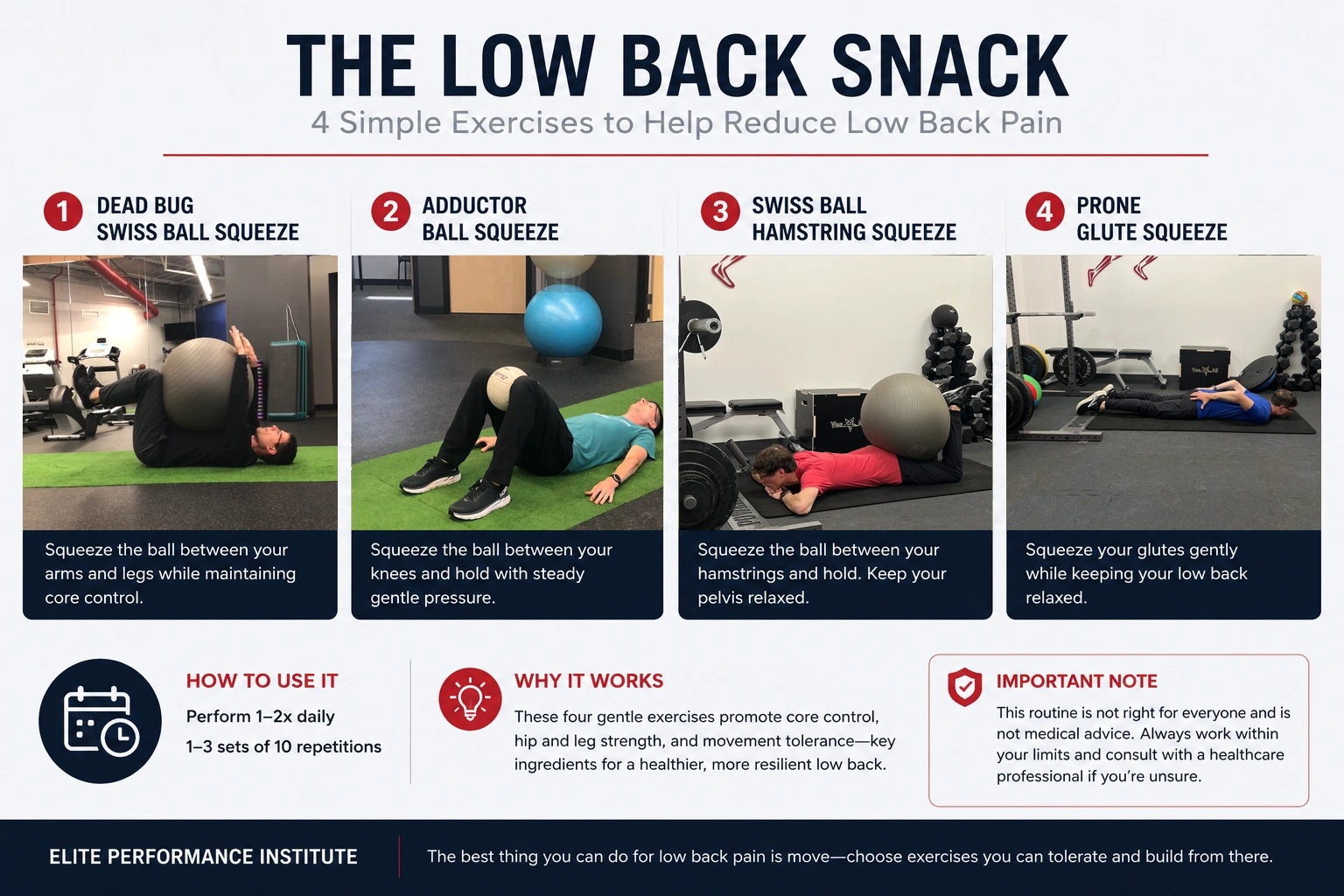
The Low Back Snack: four simple exercises I commonly use as a starting point for low back pain.
The Low Back Snack: 4 Exercises I Commonly Use
I like this routine because each exercise is relatively simple, does not require heavy loading, and can be modified. Together, the exercises challenge the trunk, adductors, hamstrings, and glutes without requiring a complicated workout.
The goal is not to exhaust yourself. Think of this as a small dose of quality movement—a “snack”—that you can repeat during the day.
Exercise 1
Dead Bug Swiss Ball Squeeze
This is one of my favorite low-level core exercises because it allows someone to create a lot of trunk tension without requiring much spinal movement.
Lie on your back with the hips and knees near 90 degrees and place a Swiss ball between the forearms and shins. Gently squeeze the arms and legs into the ball while keeping the ribs down and breathing normally. Relax, then repeat.
Modification: If actively holding your legs in the 90/90 position bothers the hips or low back, support or elevate the lower legs on a chair, bench, couch, or similar surface. You can still work on creating abdominal pressure without asking the hip flexors to hold the legs in the air.
Exercise 2
Adductor Ball Squeeze
The adductor ball squeeze is about as simple as an exercise gets, which is one reason I like it. Lie on your back with the knees bent, place an object between the knees, gently squeeze it, relax, and repeat.
You do not need a specific piece of equipment. A slightly under-inflated volleyball works great, but a basketball, soccer ball, yoga block, Swiss ball, foam pad, pillow, or another comfortable object can work.
The goal is a controlled inner-thigh contraction without holding your breath, twisting, or trying to squeeze as hard as humanly possible.
Exercise 3
Prone Hamstring Curl With Swiss Ball
This is the hamstring component of the Low Back Snack. Lie on your stomach with the ankles resting on a Swiss ball. Curl the heels toward the glutes, control the ball, then slowly return to the starting position.
I want the movement smooth and controlled. Keep the pelvis relatively quiet and do not turn the exercise into a big low-back extension movement.
If the full curl does not feel comfortable, reduce the range and work only through the portion you can tolerate.
Exercise 4
Prone Glute Squeeze
Finish the routine with one of the simplest glute exercises in my library. Lie on your stomach and squeeze the glutes without lifting the legs or excessively arching the low back.
I like this exercise because there is very little to coordinate. The person can focus on creating a clean glute contraction while keeping the pelvis still.
Squeeze, hold briefly, relax completely, and repeat.
How I Program the Low Back Snack
- Frequency: 1–2 times per day
- Sets: 1–3 sets of each exercise
- Repetitions: 10 quality repetitions
- Effort: controlled, moderate effort—not maximal squeezing
- Range: only through a range that feels comfortable and controlled
I intentionally keep the routine simple. Someone who is having a rough day may start with one set. If everything feels good, they may progress toward two or three sets.
More is not automatically better. I would rather see 10 controlled repetitions that feel good than 30 rushed repetitions performed through increasing discomfort.
What If One of the Exercises Hurts?
Skip it or modify it.
There is nothing magical about these exact four exercises. They are simply four options I commonly use because many people tolerate them well and they are easy to perform at home.
If one exercise clearly increases your symptoms, do not force it because it happens to be part of the routine. Try a smaller range, reduce the intensity, add support, or choose a different movement.
You can browse additional options in the Elite Performance Institute Exercise Library, including the Core Exercise Library, Glute Exercise Library, Hamstring Exercise Library, and Adductor Exercise Library.
The Goal Is to Build From What You Can Tolerate
Low back pain can make people afraid to move, but recovery usually is not about avoiding movement forever. It is about finding movements you tolerate, building confidence, and gradually increasing what your body can do.
The Low Back Snack is not intended to be an entire rehabilitation program. It is a simple starting point.
As symptoms improve, I typically want people doing more—not staying on four low-level exercises indefinitely. That may eventually mean walking more, lifting, squatting, hinging, carrying, running, or returning to whatever activities matter to that person.
This routine is not appropriate for every type of back pain. Seek an appropriate evaluation if you have significant trauma, progressive weakness, new numbness in the groin or saddle region, new bowel or bladder changes, fever or systemic illness, unexplained weight loss, or symptoms that are severe or rapidly worsening.
The Bottom Line
Low back pain is incredibly common, and most cases are non-specific. That can be frustrating, but it also means there often is not one fragile structure that needs to be protected from all movement.
For many people, the better strategy is to stay active, find exercises that are tolerable, and gradually build capacity.
The Low Back Snack is one simple way I introduce that idea in the clinic: four exercises, minimal equipment, and a small dose of movement that can be repeated during the day.
It does not have to be complicated. Start with what you can tolerate, focus on quality, and build from there.
Frequently Asked Questions About the Low Back Snack
How often should I do the Low Back Snack?
I commonly use it 1–2 times per day for 1–3 sets of 10 repetitions per exercise. That is a general starting point, not a requirement for every person.
What if holding my legs at 90/90 during the dead bug bothers my back or hips?
Support or elevate the lower legs on a chair, couch, bench, or similar surface. This reduces the demand of actively holding the legs in the air while still allowing you to work on trunk control.
Do I need a special ball for the adductor squeeze?
No. A volleyball, basketball, soccer ball, yoga block, Swiss ball, foam pad, pillow, or another comfortable object can work.
Should low back exercises hurt?
I do not want someone forcing an exercise through sharp or clearly worsening pain. Some effort or mild awareness can occur, but the movement should remain tolerable and controlled.
Are these the best four exercises for everyone with low back pain?
No. They are simply four exercises I commonly use because they are easy to modify and many people tolerate them well. Exercise selection should match the person, symptoms, goals, and current ability.
Is bed rest good for low back pain?
For uncomplicated non-specific low back pain, modern guidance generally encourages staying active and continuing normal activities as tolerated rather than prolonged inactivity.
References
- World Health Organization. Low Back Pain. Updated June 19, 2023.
- National Institute for Health and Care Excellence. Low back pain and sciatica in over 16s: assessment and management. NICE Guideline NG59.
- Dieleman JL, Cao J, Chapin A, et al. US Health Care Spending by Payer and Health Condition, 1996-2016. JAMA. 2020;323(9):863-884. doi:10.1001/jama.2020.0734.
Low Back Pain Keeping You From Doing What You Want?
At Elite Performance Institute, we focus on helping people understand what they can do, finding movements they tolerate, and building a plan that progresses beyond temporary symptom relief.
This article is for general educational purposes and is not medical advice. These exercises are not appropriate for every person or every cause of low back pain. If you are unsure whether an exercise is appropriate for you, seek an individualized evaluation from a qualified healthcare professional.