
The Best Glute Exercises for Runners
As an established clinician and track and field coach for the past 18 years, I work with a multitude of runners. One of the most common questions I get is simple: what are the best glute exercises for runners?
I hear the same idea phrased in all kinds of ways. Some runners say their glutes are weak. Others say their glutes are not activated or not firing. Regardless of the wording, glute training matters for runners. If you want a larger list of options, check out my glute exercise library. It includes many of the glute exercises I commonly prescribe in the clinic.
Quick answer: The best glute exercises for runners are not always the ones with the flashiest band burn or the highest EMG number. I generally like a mix of stronger glute max exercises that train hip extension and force production, along with glute med/min exercises that improve frontal-plane control, pelvic stability, and single-leg mechanics. In most cases, a few well-chosen exercises done well will beat a huge list of random glute drills.
Why Runners Care So Much About the Glutes
Glute strength matters because running is a repeated single-leg activity. The glutes help control the pelvis, hip, femur, and lower leg as the foot hits the ground.
When this area is underprepared, some runners show more hip drop, poorer single-leg control, or more difficulty holding mechanics as they fatigue.
That does not automatically mean every runner has “lazy glutes.” It also does not mean every injury is a glute problem. Still, glute strength and control deserve a real place in a runner’s program.
The big idea: runners usually do best with a combination of glute max strength and glute med/min control work, not just endless clamshells or monster walks forever.
Glute Anatomy: Why It Matters
People often group all of the glutes together, but they are not all doing the exact same job.
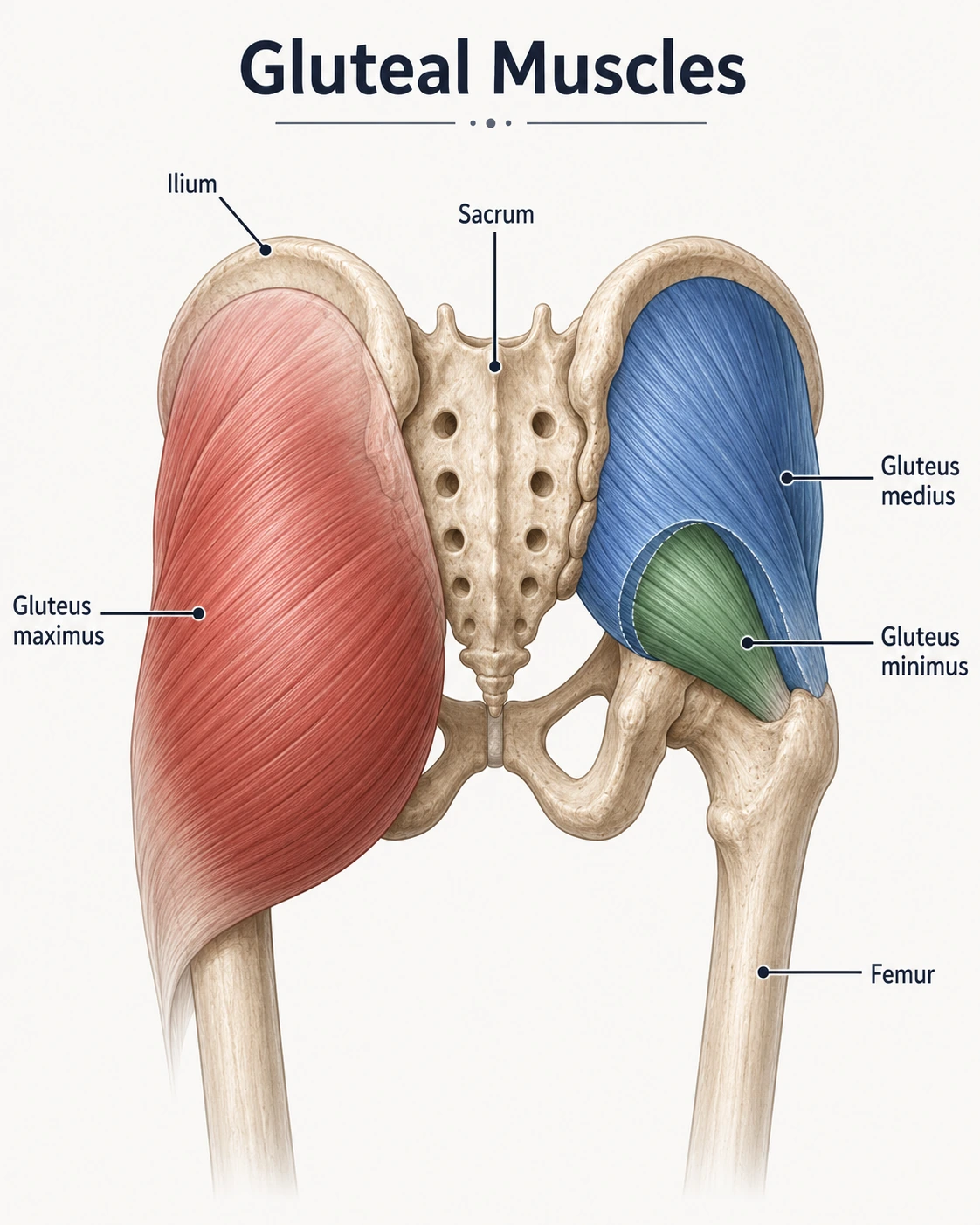
Gluteus maximus, gluteus medius, and gluteus minimus anatomy.
Gluteus Maximus
The glute max is the large, powerful hip extensor. It plays a major role in force production, hip extension, and stronger lower-body movement. For runners, I tend to think about it through the lens of strength, propulsion, and tolerance to bigger efforts like hills, harder workouts, and running when fatigue sets in.
Gluteus Medius and Minimus
The glute med and glute min are more tied into frontal-plane control, pelvic stability, and single-leg mechanics. These are often the muscles runners are really talking about when they say their hips are weak, unstable, dropping, or not “firing” right.
This distinction matters in the clinic. A runner will often tell me, “I work my glutes all the time.” Then I ask what they are doing, and the answer is usually glute bridge variations. Bridges are not bad. But they do not mean every part of the glutes is strong. A runner can be decent at bridges and still be weak in the glute medius or glute minimus. That is especially true when lateral hip control and single-leg stability are the real problem.
Why EMG Does Not Fully Answer the Question
EMG studies can be interesting, but I would be careful about using them to crown one exercise as the single best glute exercise for runners. EMG data can change based on setup, body position, tempo, load, coaching cue, electrode placement, and how the numbers are normalized.
A higher EMG signal also does not automatically mean the exercise is better for long-term carryover, progression, tolerance, or practical usefulness. That is one reason I think people can get too caught up in chasing the “best” glute max or glute med exercise on paper instead of choosing exercises they can load, control, and progress over time.
My take: EMG can be one piece of the puzzle, but it is not enough by itself to choose the best exercise. Exercise selection still depends on the runner, the goal, the season, the symptoms, and what fits the program well.
My 3 Favorite Glute Max Exercises for Runners
If I had to pick three glute max-focused exercises from my library that I really like for runners, these would be high on the list. I tend to use these when I want more strength-oriented glute max work, not just easier low-level prep drills.
1. Box Step-Up
I love the box step-up for runners because it is honest single-leg work. It trains hip drive, lower-body strength, and control in a position that feels much closer to the demands of running than many machine-based gym exercises. It is also easy to load and easy to progress.
2. Bulgarian Split Squat
This is one of my favorite heavier glute max and overall lower-body strength options for runners who are ready for it. It challenges the glutes, quads, and hip stabilizers while forcing single-leg control. For runners who tolerate it well, it is hard to beat as a stronger stimulus.
3. Glute Bridge With Feet Elevated
I like this one because it gives a clear hip-extension stimulus and can load the posterior chain without making things too complicated. It works well as a bridge between simpler glute bridge work and more demanding single-leg options.
If I were mentioning a fourth, the kettlebell swing would absolutely deserve consideration, especially for runners who are experienced with hinging and want something more dynamic.
My 3 Favorite Gluteus Medius/Minimus Exercises for Runners
When I am thinking more about the gluteus medius and gluteus minimus, these are three exercises I like because they each challenge lateral hip function a little differently. They also make more sense to me than assuming all glute work is the same.
1. Modified Side Plank With Hip Abduction
This is one of my favorite glute med/min exercises for runners because it gives you lateral chain work without being just another side-lying hip exercise. It combines hip stability, pelvic control, and trunk control in a way that makes a lot of sense for runners.
2. Standing Fire Hydrant
I like the standing fire hydrant because it is more functional than the classic quadruped version. It brings in balance, single-leg control, and upright hip work. That makes it more useful for runners than just staying on all fours forever.
3. Monster Walks
Monster walks are still a favorite of mine because they are simple, practical, and easy to slot into a warm-up or accessory circuit. They are not the only glute exercise runners need, but they are still a very good banded option for building lateral hip demand with movement.
Is There One Best Glute Exercise for Runners?
No, and I think that is an important point.
Certain runners will tolerate or prefer one move over another. Some runners do great with step-ups. Some do better with split squats. Some feel a monster walk really well. Others feel much more benefit from standing fire hydrants or side plank hip work.
At the end of the day, there is not necessarily one superior exercise. The better approach is usually to find a few exercises that make sense for the runner in front of you and then progress them well. A change in stimulus over time is also a good thing. I do not think runners should get married to one glute drill for the rest of their life.
How I Like to Program Glute Exercises for Runners
I still like to follow the same principle I laid out in my other strength blogs: lower reps, more intent, and enough load to matter.
- Usually 3 total sets in a session
- Usually 6–12 reps per side or per set
- Enough resistance that the exercise is actually challenging
- Enough rest to keep the reps clean
For drills like monster walks, I still like the same general idea of making the band tension meaningful and keeping the sets honest.
I also would not do the exact same glute circuit every day. Runners usually do better when glute work is organized, progressed, and rotated intelligently rather than done randomly forever.
How This Fits Into the Bigger Picture
Glute work matters, but it should not be isolated from the rest of the runner strength conversation. If you want the broader picture, check out my Best Strength Exercises for Runners article. Glute work is one important piece, but runners also need calf work, hamstring work, trunk control, and main lower-body strength.
Bottom line: the best glute exercises for runners are the ones that actually fit the runner, challenge the right qualities, and are progressed over time. For me, that usually means stronger glute max work like step-ups, Bulgarian split squats, and bridge variations combined with glute med/min work like modified side plank with hip abduction, standing fire hydrants, and monster walks.
Frequently Asked Questions About Glute Exercises for Runners
Do runners really need glute exercises?
In most cases, yes. Running is a repeated single-leg activity, and the glutes help control the pelvis, hip, and lower extremity.
What is the best glute max exercise for runners?
There is not one universal best exercise, but I especially like box step-ups, Bulgarian split squats, and stronger bridge variations for glute max-focused work.
What is the best glute med exercise for runners?
Modified side plank with hip abduction, standing fire hydrants, and monster walks are all strong options depending on the runner and the goal.
Do glutes need to be “activated” before every run?
Sometimes a little prep work can make sense, but I think the bigger issue is building actual glute strength and control over time rather than obsessing over activation terminology.
How often should runners train glutes?
That depends on the runner and the rest of the program, but I would rather see consistent, progressive glute work a few times per week than random band work done without structure.
Want More Glute Exercises for Runners?
Browse my Glute Exercise Library for a larger list of glute exercises I commonly use with runners and active people in the clinic.